
The Cultural Bridge: The Power Adapter
Direct vs. Performative Communication Protocols.

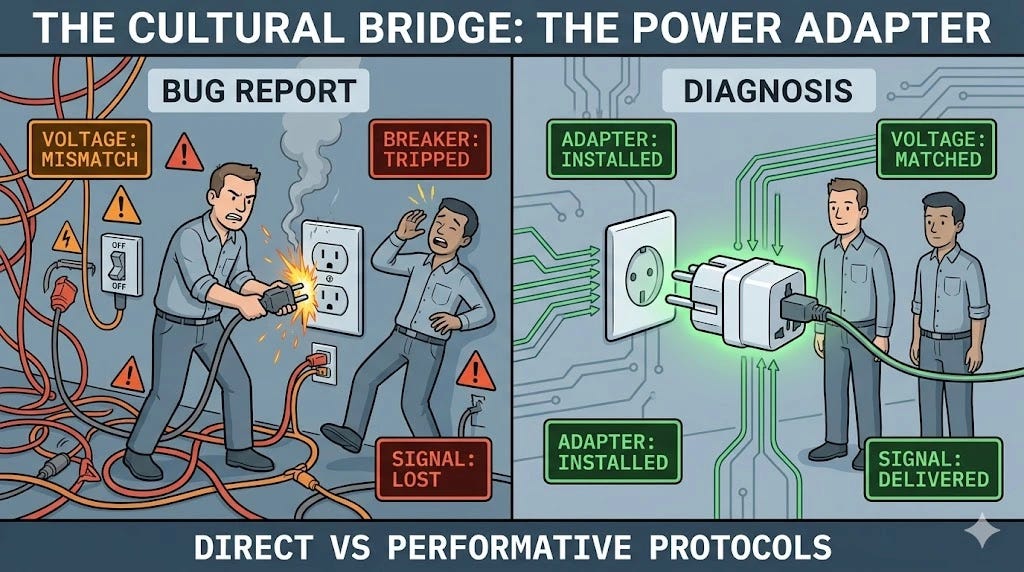
Every guide to working across cultures hands you the same useless advice. Read the room. Be aware of differences. Adapt your style. This is the communication equivalent of telling a drowning person to swim. It names the goal and skips the mechanism.
Here is the mechanism. You and the person across the table are running on different electrical grids. Your communication has a native voltage, and so does theirs. Plug a high-voltage, direct culture straight into a low-voltage, performative one and you trip the breaker: your point never lands because they are too busy recovering from the shock. Plug a performative signal into a direct receiver and nothing arrives at all, just insulation and no current. This is sub-system 7 of the Active Balance arc, and it is the one that quietly ends careers in multinational companies.
Voltage, Not Content
The single most important property of a power adapter is that it changes the voltage, not the data on the wire. The bits arriving at the device are identical. Only the delivery is converted so it does not fry the hardware.
Cross-cultural communication works the same way, and most people get it exactly backwards. They assume adapting their style means diluting their message. It does not. A voltage converter does not censor the signal. It matches the local grid so the signal survives the trip.
Keep the engineering truth. The design is still flawed. The deadline is still impossible. The plan still has a race condition. What changes is the voltage at which you deliver it, not whether you deliver it. If you sand off the actual data to be polite, you have not built an adapter. You have cut the wire.
Stepping Down: Direct Into Performative
If your native grid is high-voltage, the Slavic or Dutch or Israeli end of the dial, you have spent your life delivering current at full force and it worked fine at home. Then you plug into a low-tolerance grid and trip the breaker on contact.
“This design is wrong” is a clean, true, 230-volt statement. In a performative culture it does not register as information. It registers as an attack. Now the entire room is debugging your tone instead of your point, and the flaw you correctly identified ships anyway. You were right and you lost. (This is the failure mode behind Why Being Correct Isn’t Enough.)
A step-down converter delivers the same data at a voltage the grid accepts. “I see a problem in this design, here is the failure case” carries the identical payload. This is not a compliment sandwich. A compliment sandwich lies about the data, padding a real defect with fake praise until the defect gets lost. A converter does not touch the data. It only lowers the voltage so the truth arrives intact instead of bouncing off a tripped breaker.
Stepping Up: Performative Into Direct
The direction nobody teaches is the other one. You are the direct receiver, and a performative culture is transmitting at you. To your ear it is all padding and no signal. You walk out of the meeting thinking it went well. It did not.
You need a step-up converter on the input: strip the insulation, recover the actual data. In a high-context culture the real message is encoded in the gap between the words. “That is an interesting idea” is frequently a no. “Let us follow up on that separately” often means “you are wrong and I will not embarrass you in public.” “I have some concerns” can mean the project is already dead. If you take these at face voltage, you will keep missing the real signal and wondering why decisions seem to happen without you.
Learn the local encoding. The padding is not noise. It is the protocol, and it carries data you are currently throwing away.
Install the Adapter, Do Not Rewire Yourself
Here is the failure mode that burns out your best people. They conclude the answer is to become performative. They try to rewire their own internal voltage to match the grid permanently.
This does not work, for the same reason you do not resolder a laptop’s power supply every time you cross a border. You carry an adapter. Rewiring yourself fries the device. You lose your edge, you exhaust yourself running a translation layer at full load every waking hour, and worse, your own team can no longer read you, because you have started padding your signals to them too.
Keep your native voltage. Build a clean adapter and plug it in consciously at the boundary, the cross-cultural interface where the grids actually meet. Unplug it with your own direct-culture people, where full voltage is the correct protocol and padding is just latency. The adapter is hardware you carry to the border. It is not a personality transplant, and it is not an apology for who you are.
The Request
Find your current mismatch this week. Pick one. Either you are tripping breakers, a true statement that keeps bouncing because the voltage is wrong for the grid, or you are missing signal, a performative phrase that keeps confusing you because you read it at face value.
If you trip breakers, take your most common high-voltage statement and write its step-down version. Same data, lower voltage. If you miss signal, take the performative phrase that keeps fooling you and write down what it actually means on that grid. Build exactly one adapter. Carry it to the next meeting and plug it in.
Then tell me in the comments which direction you run. Are you the one tripping breakers, or the one missing the signal under the padding? And what is the one phrase on your current grid that took you the longest to decode?
System Library
The Talk: Erin Meyer: Working Across Cultures
The cross-cultural researcher walks the specific axes where grids differ, including the direct versus indirect feedback scale. Watch it to see your own native voltage plotted against the people you keep shocking.
The Field Manual: When Cultures Collide by Richard Lewis
Lewis sorts cultures into linear-active, multi-active, and reactive, a different wiring diagram than most. Use his model to locate your own grid and predict exactly which other grids your voltage will short out.
The Concept: Code-Switching
The linguistic term for changing your register or language by context without changing who you are. This is the adapter named precisely. You switch the delivery at the boundary, you do not rewire the speaker.
System Status
Theory is for brochures. Engineering is for survival. If your team ships flawed work because true feedback keeps tripping the breaker, or decisions keep happening in a language you cannot decode, I provide Strategic Debugging and Mentoring. Review the operating parameters at weivco.com.
Elsewhere: I write about building software with AI at The Old Man and the AI, and I build Fractbox, a browser-based 3D fractal engine.