
The Physics of Active Balance
Your "work-life balance" is not a ledger. It is a PID controller

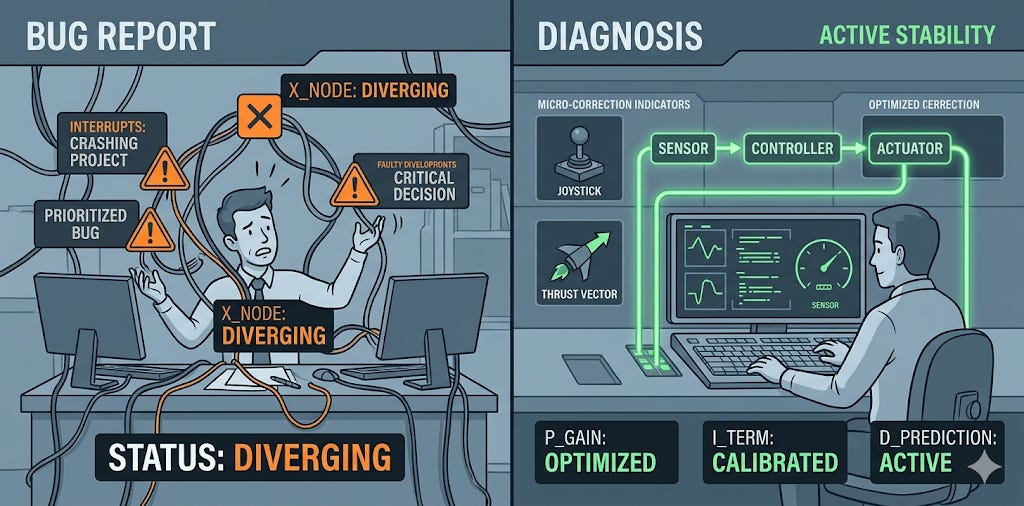
The term “work-life balance” is a marketing hallucination designed for HR brochures and LinkedIn influencers. It implies a scale. It suggests you can dump a fixed amount of “career” on one side, a pile of “personal life” on the other, and achieve a permanent, static equilibrium.
In engineering terms, this is a catastrophic diagnostic failure. Human systems are not static. They are high-variance, stochastic environments characterized by constant external interrupts. Attempting to apply a static model to a dynamic system is why you are currently redlining. You do not need a scale. You need a PID, Proportional-Integral-Derivative, controller.
Stability is not a position. It is an active expenditure of energy to maintain a desired state against constant force. If you stop the active correction, the system diverges. Every time.
The Equilibrium Myth: Static Models in Dynamic Environments
Most managers operate under the assumption that balance is a “set it and forget it” configuration. They believe that if they optimize their calendar once, they are finished. This logic fails the first time a project slips, a critical bug emerges, or a manager shifts priorities.
When the environment shifts, the carefully calibrated weights on your metaphorical scale fly off. The system destabilizes. This is not a failure of your initial setup. It is the expected behavior of any static model attempting to survive in a dynamic environment. You are attempting to use a spirit level to stabilize a fighter jet.
System Model: Understanding Active Stability
Observe a spinning gyroscope or a fly-by-wire system in a modern aircraft. These machines are inherently unstable. They only stay upright because of constant energy expenditure and high-frequency sensor input. They are not balanced in the traditional sense. They are actively stable.
In a professional context, balance is the act of staying upright while the ground is moving. A senior manager does not achieve stability by ignoring inputs. They maintain it by constantly re-prioritizing, re-allocating, and adjusting. This is an active, demanding, and continuous process. It requires energy. It requires functional telemetry.
Telemetry Failure and Signal Aliasing
Most of you have garbage telemetry. You ignore the “Check Engine” light until the cylinders are fused together. Irritability, sleep degradation, and cognitive lag are not personality traits. They are sensor data.
If you only sample your internal state once a quarter or during a “pulse survey,” you are aliasing the signal. You are missing the high-frequency jitters that precede a total structural failure. A controller is only as good as its sampling rate. If you are not monitoring your human hardware daily, you are flying blind.
The PID Logic of Personal Hardware
To survive the management stack, you must map your efforts to the three components of a control loop.
Proportional (The Present): This is your linear response to the current dumpster fire. If the load spikes, you push back. Most of you live entirely in this state, which results in a sawtooth wave of stress and exhaustion. You are reacting to the error without addressing the physics.
Integral (The Past): This is the accumulated error, or “Burnout Debt.” If you have been over-clocking for six months, you have a massive integral signal. You cannot fix this with a long weekend. The math does not allow it. High integral debt requires a sustained, long-term counter-correction to bring the system back to the baseline.
Derivative (The Future): This is predictive braking. It is the rate of change. If your input queue is growing faster than your throughput, the system will diverge. High-performing hardware applies the brakes before the impact, not during the post-mortem.
The Vacation Reboot Fallacy
A vacation is not a solution. It is a system reboot. It clears the memory buffers and restarts the services. If you have a memory leak in your operating logic, the reboot only buys you a few hours of uptime.
You return to the same unstable architecture and the same unmanaged input buffer. Within forty-eight hours, the system returns to thermal throttling. A reboot is not a re-architecture. If the underlying control loop is broken, the system will always diverge.
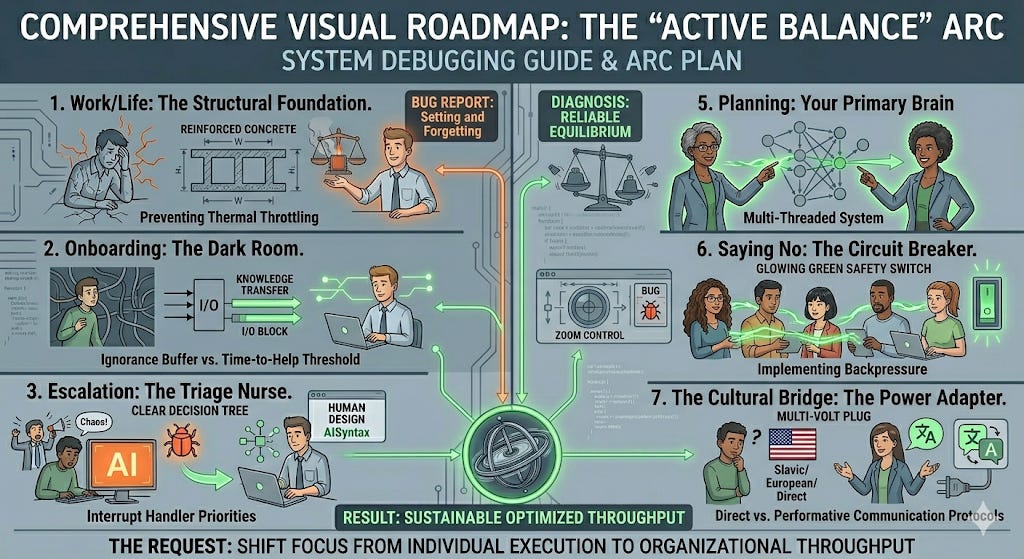
The Active Balance Arc: A System Debugging Guide
Over the next few weeks, I will debug the specific sub-systems that require active correction to ensure your professional life does not brick itself.
Onboarding: The Dark Room (Ignorance Buffer vs. Time-to-Help Threshold).
Escalation: The Triage Nurse (Interrupt Handler Priorities).
Planning: The Camera Lens (Macro bugs vs. Wide-angle Roadmap).
The Cultural Bridge: The Power Adapter (Direct vs. Performative Communication Protocols).
Stop chasing equilibrium. It is a death state. Start mastering the dynamic correction.
The Request
Implement a daily system check this week. Block 15 minutes. Review your energy levels, your task load, and your stress baseline. Identify one parameter that is causing the system to diverge. Make one small adjustment. Immediately. This is your PID loop in action. Do not wait for a full hardware failure.
System Library: External Technical Bedrock
The following resources provide the physical and engineering foundations for the Active Balance protocol. Read them to understand the mechanics. Do not read them for “inspiration.”
The Foundation: Choose Boring Technology
This is the definitive text on managing innovation tokens. It explains why every new tool in your stack is a liability that increases system entropy.
The Controller: PID Tuning Guide
A technical breakdown of Proportional, Integral, and Derivative logic. It provides the mathematical proof that “just trying harder” is not a control strategy.
The Throughput: Theory of Constraints
A briefing on why unmanaged work is a physical toxin to a system. If you do not manage the bottleneck, you are not managing the organization.
The Hardware Constraint: Cognitive Load is What Matters
An engineering analysis of the human brain’s I/O constraints. It treats developer confusion as a measurable system cost.
The Model: Fly-by-Wire Systems
The technical reality of active stability. Understand how computers maintain flight in inherently unstable airframes.
System Status: Critical?
Writing about management is theory. Fixing it is engineering. If your organization is suffering from high latency, packet loss in communication, or structural debt, I provide Strategic Debugging and Mentoring. Review the operating parameters at weivco.com.
Elsewhere: I write about building software with AI at The Old Man and the AI, and I build Fractbox, a browser-based 3D fractal engine.