
Your Accent Is Latency, Not Bandwidth
Why the room rounds your IQ down by your pronunciation, and how to route around it.

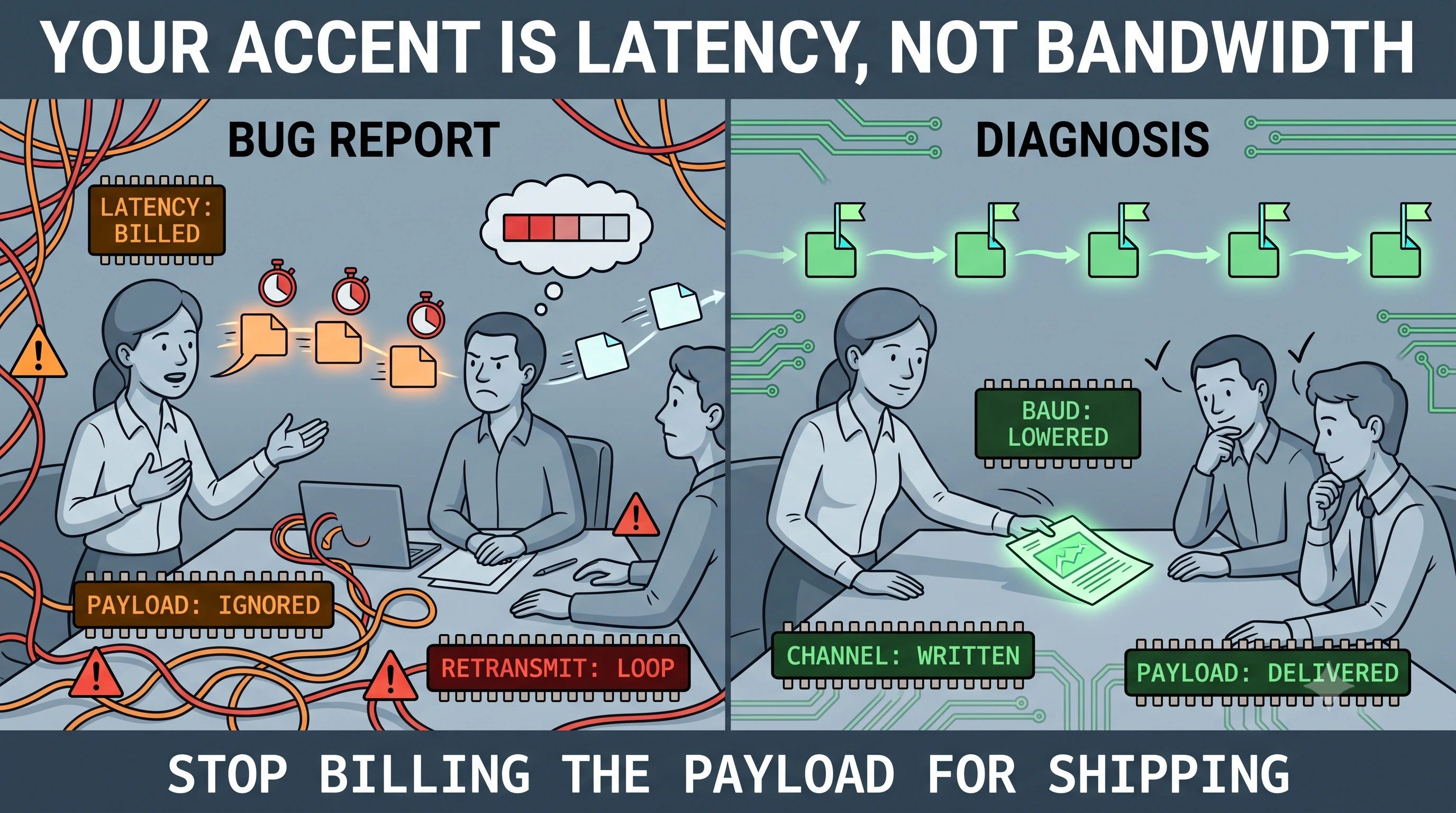
You prepared the argument for a week. You delivered it in your third or fourth language. Most of the room has one. They heard the accent, silently added decode overhead, and rounded your competence down to match. Nobody decided to do this. The bias runs at the protocol layer, below anyone’s intentions, and it will quietly tax every spoken word of your career unless you engineer around it.
This is the Foreign Engineer’s Field Guide, translation lane, and this entry is about the difference between two numbers everyone conflates.
Latency Is Not Bandwidth
Latency is how long the payload takes to arrive and be decoded: a property of the channel, not of the data. Bandwidth is how much you can transmit. They are different axes, and confusing them is a beginner mistake in networks and a universal mistake in meetings.
An accent is decode latency, full stop. The receiver spends a few extra milliseconds per word resolving your phonemes against their expectations, with an occasional retransmit: “sorry, say that again?” That is transport overhead. It says nothing about the payload: the quality of the design, the correctness of the objection, the rate of actual ideas per minute, which is your bandwidth, and which may be the highest in the room.
But receivers do not file the cost where it belongs. Decoding you takes effort, the effort feels like something being wrong, and the something gets billed to you. Harder to parse gets rounded to less competent. This is a known defect in human receivers, and it means your ideas are being invoiced for shipping.
The Retransmit Spiral
The two axes are independent, right up until you mismanage the latency. Then it starts eating your throughput, and here is the loop. You notice the decode strain on their faces. You speed up to get through it, which increases packet loss, which triggers more retransmits, which increases the strain. Or you take the other branch: you stop transmitting in meetings entirely. Your measured bandwidth drops to zero, and now the room’s misreading of you is empirically true. They wanted throughput. You gave them silence. The bias closed its own loop.
Then the routing changes. Decisions flow toward the cleaner audio. Your idea arrives in the room through someone else’s mouth, six days later, renamed. Video calls make all of it worse: a lossy channel stacked on top of your latency, with no lip data to help the parser.
None of this happened because your ideas were weak. It happened because the room priced the transport and never audited the payload.
Route Around the Lossy Channel
Receivers do patch themselves, eventually. Give a team a month of daily standups and your decode cost drops toward zero. Exposure is the real fix, and it argues for transmitting more, not less. But the decision meeting will not wait a month, and every new room resets the clock. For the exchanges that cannot wait, re-engineer the routes.
Go write-first. Text has almost no accent: the decode tax on your written English is a rounding error next to the spoken one. Move your highest-stakes payloads to the written channel and let the meeting be the place where your doc gets discussed, not where your larynx gets graded. This is not the silence branch. You still transmit in the room. The doc carries the payload. Your voice defends it.
Drop your baud rate. This is the counterintuitive one. Slowing down feels like surrender. It is the opposite. A lower symbol rate cuts packet loss, kills the retransmit loop, and denies the room its excuse: nobody can bill you for retransmits that never happen. Slow and structured reads as deliberate. Slow and rambling just reads as slow.
Send headers. Front-load structure: “Three points. First.” A receiver who knows the shape of the packet can survive dropped phonemes and reassemble the payload. Structure is redundancy, and redundancy is how you transmit through a lossy channel. On video, wear the good microphone and turn captions on. Live captions are forward error correction you get for free.
Stop pre-paying the toll. Do not open with “sorry for my English.” That line announces overhead before the first packet arrives and primes the exact bias you are trying to defeat.
Optimize Intelligibility, Not Identity
The accent-reduction industry sells the wrong metric. It promises to make you sound native, which is mimicry, expensive, and mostly unattainable past a certain age. The metric that matters is intelligibility: packet loss rate. Can the receiver reassemble your payload on the first pass? That you can train, and it is worth training.
But do not confuse the fingerprint with a defect. Your accent is a protocol signature. It announces that there are other stacks running under this one, that the speaker holds more than one compiler. The room that bills you for it is making an accounting error. Your job is to stop subsidizing the error, not to erase the evidence of where you compiled.
The Request
Two experiments this week. Keep sending headers and skip the apology every time; those aren’t experiments, they’re just how you talk now. First, take your highest-stakes recurring exchange, the one where you keep losing to cleaner audio, and move it write-first: send the doc before the meeting, then defend a text everyone already parsed. Second, pick one meeting and cut your speaking speed by a third. Count the retransmits. Compare the count to a normal meeting and see which version of you the room actually heard.
Then tell me in the comments about the worst billing error you have eaten: the idea that lost because of the audio and won six days later out of someone else’s mouth. And if you found a compensation that works, post it. The workaround list helps everyone behind you.
System Library
The Talk: Why I Keep Speaking Up, Even When People Mock My Accent by Safwat Saleem
An artist who stopped doing voiceovers after the internet mocked his accent, and what it took to transmit again. Watch it for the exact moment the spiral closes, silence as the final packet loss, and for the way out.
The Concept: Latency
The engineering definition this post runs on. Keep the two axes separate in your head and you will stop letting other people collapse them onto you.
The Field Manual: English with an Accent by Rosina Lippi-Green
The standard book on accent discrimination: how “standard English” functions as an ideology, and who gets billed for deviating from it. Field evidence that the penalty is systemic, documented, and not in your head.
System Status
Theory is for brochures. Engineering is for survival. If your best ideas keep losing to worse ideas delivered in cleaner audio, or you have gone quiet in the rooms where you used to be the signal, I provide Strategic Debugging and Mentoring. Review the operating parameters at weivco.com.
Elsewhere: I write about building software with AI at The Old Man and the AI, and I build Fractbox, a browser-based 3D fractal engine.