

Every engineer who moves to a new country tells themselves the same comforting lie. Code is universal. Logic is logic. The language is English and the job is the same job, so I will just run. You are wrong, and you will spend years debugging the wrong layer before you work out why.
You are software, and you were compiled for a specific locale. Not the language, the locale: the full set of defaults you never had to think about because at home they were simply the environment. How you greet. How you joke. How you disagree. How fast you are expected to arrive. Whether you announce your own work or wait to be noticed. None of that is your core logic. All of it is locale-specific presentation, and none of it ports cleanly to a new machine.
The Locale You Compiled In
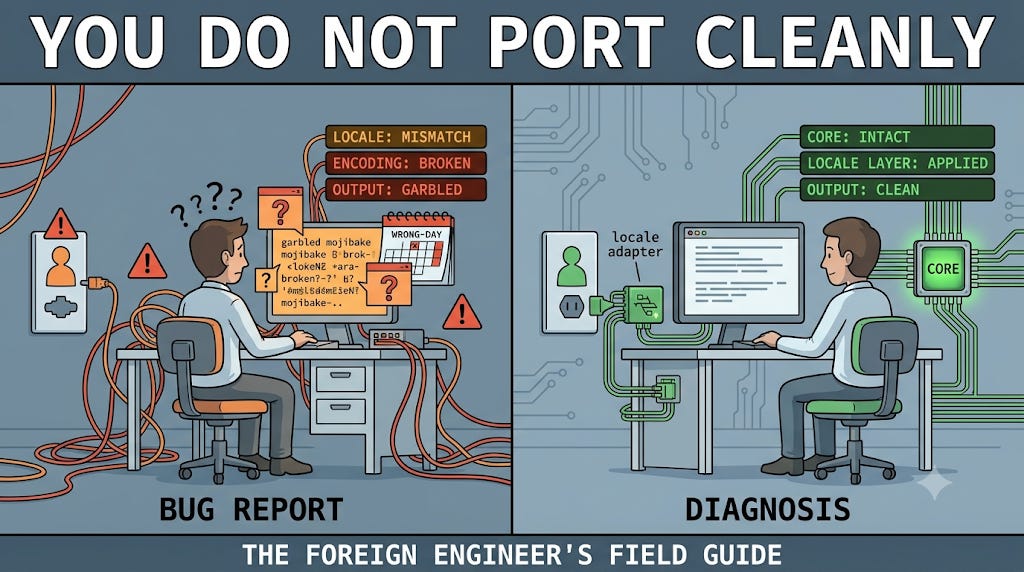
A program does not see its own locale. It just runs, and the dates come out right and the strings render and the assumptions hold, because the environment matches the one it was built for. Move the same binary to a different locale and the logic still executes, but everything around it starts producing garbage. The text turns to mojibake. The date reads as the wrong day. The sort order is nonsense.
You are the binary. Your engineering skill is the core logic, and it ports fine. That is the part that fooled you. Everything wrapped around it, the parts that made you effective at home, was tuned to a locale you are no longer running in. The competence transfers. The presentation does not.
Two Ways It Breaks
The errors come from two layers, and this field guide debugs both.
The first is translation: cultural protocols that decode to garbage on the new grid. Your joke lands as an offense. Your honest “this is broken” reads as a bad attitude. Your refusal to brag reads as having nothing to show. Your name gets mangled into something you eventually stop correcting. The signal you are sending is not the signal they are receiving.
The second is mechanics: the local system that expects a format you were never issued. Your degree and your years of experience get mis-parsed by a leveling process built for a different resume. Your network is empty because you have no alumni and no childhood weak ties to call. Your right to stay is wired to a single employer. These are not communication problems. They are structural, and ignorance of them is expensive in a different way.
Do Not Recompile Yourself
There are two failure responses, and both are common.
The first is to recompile yourself for the new locale. Overwrite your defaults. Become performative, become relentlessly positive, sand off the directness, change your name to something the local grid parses on the first try. This is lossy, and it does not even work. You burn enormous energy running a full translation layer every waking hour, you lose the edge that made you worth hiring, and the people who knew the real you can no longer read the copy.
The second is to refuse to localize at all. Keep transmitting at full home voltage, insist the locale is wrong, and keep throwing the same encoding error into the same wall. This is not integrity. It is a process that crashes on startup and blames the operating system.
The fix is the boring engineering one: internationalization. Separate your core logic from the locale-specific presentation. Keep the core intact. Build a thin locale layer and apply it at the boundary, consciously, where the grids actually meet. You already have one example shipped: the Power Adapter for the directness layer. The rest of this arc builds the other adapters.
The Field Guide
Over the next stretch I will debug the layers, one per post. Two lanes.
Translation, the protocols that do not decode:
Jokes: the untranslatable payload. Humor is maximum compression, and it needs the shared dictionary you left at home.
Pessimism: error-first by default. Why your honest defect report reads as negativity.
Names: your name is a primary key, not a UX inconvenience to smooth away.
Accent: latency, not bandwidth. Judged on protocol overhead instead of payload.
Punctuality: hard real-time versus best-effort scheduling.
The Ambiguous ACK: “yes” confirms receipt, not commitment. Why plans built on warm yeses collapse.
Honorifics: the access-control list nobody documented.
After-Work Drinks: the undocumented API where the real decisions get written.
Mechanics, the system you lack the format for:
Visa: a single point of failure wired into your career.
Visibility: observability for the modest, because silent work gets deprioritized.
Credentials: schema mismatch, when your experience will not deserialize.
Network: the cold-start problem, building from zero seed data.
And between the lanes, an interlude on the difference that splits them: which of these problems are yours to patch, and which belong to a kernel where nobody issued you root.
The Request
Find the layer currently throwing your loudest error. Not the vague feeling that you do not fit. The specific one: the joke that landed wrong, the feedback that earned you a reputation, the promotion that went to someone you out-engineer, the room where decisions happen without you. Name the layer. That is the one to localize first, and it is the one the next post in this arc is most likely about.
Then tell me in the comments which locale you compiled in, and which layer broke first when you moved. The specific failure is more useful to the rest of us than the theory.
System Library
The Talk: Don’t Ask Where I’m From, Ask Where I’m a Local by Taiye Selasi
Selasi takes apart the idea of a single national origin and rebuilds identity around the locales you actually run in. Watch it to stop treating “where are you from” as a primary key and start thinking in terms of the environments that set your defaults.
The Field Manual: The Geography of Thought by Richard Nisbett
Nisbett’s evidence that East Asian and Western minds do not just value different things, they process information differently. Proof that the divergence runs below the presentation layer, into how the core itself reasons, which is why this is harder than learning local manners.
The Concept: Internationalization and Localization
The software discipline this entire arc steals from. Internationalization is building the core so it can be localized without a rewrite. That is the exact move: keep the logic, swap the locale layer, do not fork yourself per country.
System Status
Theory is for brochures. Engineering is for survival. If you are a strong engineer whose career keeps stalling on a layer you cannot see, the feedback that misfires, the work that goes unnoticed, the rooms you are not in, I provide Strategic Debugging and Mentoring. Review the operating parameters at weivco.com.
Elsewhere: I write about building software with AI at The Old Man and the AI, and I build Fractbox, a browser-based 3D fractal engine.
Love the metaphor. Core logic ports - the locale layer needs an adapter.
Lots of good insights here!