

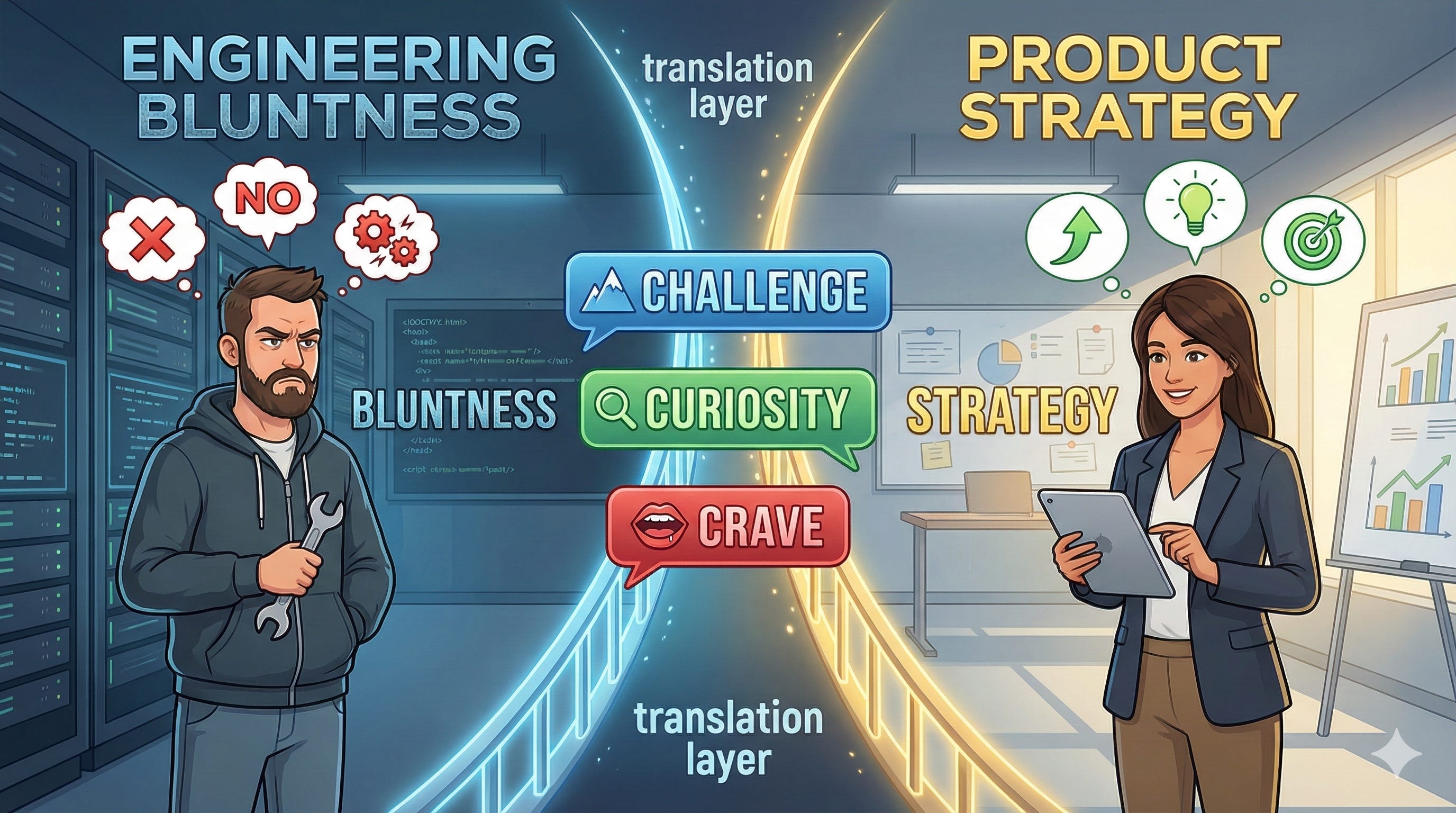
The relationship between Engineering and Product is often defined by a fundamental Impedance Mismatch.
Engineers live in a deterministic universe. We care about constraints, edge cases, and gravity.
Product Managers live in a probabilistic universe. They care about markets, user sentiment, and “blue-sky thinking.”
When these two universes collide, you get friction. To an engineer, a PM’s optimism often sounds like hallucination. To a PM, an engineer’s realism often sounds like obstruction.
Early in my career, my “Slavic Engineering” dialect (blunt, direct, skeptical) was a problem. When I said, “That is a bad idea,” I thought I was being efficient. My PM partners thought I was being a jerk.
On the flip side, their dialect was just as confusing to me - filled with “synergy,” “blue-sky thinking,” and the worst offender: using “ask” as a noun.
I realized I needed a Translation Layer. I didn’t stop being skeptical - I just changed the API.
I adopted three “magic words” that allow me to push back hard without breaking the connection.
1. “Challenge” (The Constraint Identifier)
Often, we are presented with a roadmap item that is... let’s say, optimistic. My gut reaction is to spit my drink and declare it impossible.
But saying “You are wrong” destroys the alliance. It makes it Me vs. You.
Instead, I use the word “Challenge.”
The Internal Monologue: “This timeline is delusional. The legacy backend is a mess.”
The Translation: “I see the strategic value here. The challenge we face is that the legacy infrastructure will require a month of refactoring before it can support this load.”
Why it works: “Challenge” externalizes the problem. It is no longer your opinion against their idea. It is both of you against the “Challenge.” It invites the PM to step to your side of the table to solve the puzzle with you.
2. “Curious” (The Debugger)
In engineering, we are usually trained to be skeptical, not curious. We ask “why” only when the system crashes (Root Cause Analysis).
In management, you need to run that RCA before you write code.
The Internal Monologue: “You clearly haven’t thought through the edge cases for mobile users.”
The Translation: “I am curious to understand how we plan to handle the latency limits for users on 3G networks.”
Why it works: It forces the other person to explain their logic (or lack thereof) without feeling attacked. You aren’t judging them; you are just “gathering data.”
Nine times out of ten, while answering your “curiosity,” they will realize they missed a requirement. You fix the bug in the spec, not in production.
3. “Crave” (The P0 Dependency)
I saved the best (and strangest) for last.
“Crave” is a strong word. It is visceral. Usually, it is connected to addiction.
But inside Google executive circles, we started using this word to signal Intensity of Intent.
“I want more data” sounds like a preference (P2 priority).
“I need more data” sounds like a requirement (P1 priority).
“I crave to understand the data” sounds like a biological necessity (P0 blocker).
The Situation: A roadmap is comprehensive but vague on the actual trade-offs.
The Translation: “This plan is ambitious. But I crave to see the priority stack-rank of these features so I can allocate resources effectively.”
Why it works: It implies that you want to move forward, but you are physically unable to do so without this specific input. It pushes the pressure back on the PM to provide clarity, but it does so with enthusiasm rather than skepticism.
Summary: The API Reference
Next time you are in a roadmap review and you feel your blood pressure rising, don’t default to “No.” Try the API call instead:
Identify the external blocker: “The challenge is...”
Debug the requirements: “I am curious...”
Declare your dependency: “I crave...”
It’s not about being nice. It’s about being effective.
What are your magic words? Drop me a comment below. I love a spirited discussion!
System Library: Further Reading
If you want to debug your communication protocols further:
The Concept: Strong Opinions, Weakly Held
The Engineering Angle: This is the “Monte Carlo Simulation” of conversation. State a hypothesis with 100% confidence (”Challenge”) to force a reaction, but abandon it immediately if the data (”Curiosity”) proves you wrong.
The Book: The Culture Map by Erin Meyer
The Engineering Angle: The API Documentation for International Protocols. It explains why your “direct” feedback (US/Dutch/German) causes a “System Failure” with colleagues from High-Context cultures (Japan/Brazil/France).
The Video: High Context vs Low Context Communication
The Gist: Visualizing why an American “No” is a brick wall, but a Japanese “No” is a gentle fog.
System Status: Critical?
Writing about management is theory. Fixing it is engineering.
If your organization is suffering from high latency, packet loss in communication, or structural debt, I provide Strategic Debugging and Leadership Mentoring.
I help you refactor your team like you refactor your code.
Review my operating parameters at weivco.com.
Can appreciate this framework. One thing I’ve learned is to “replace judgement with curiosity”.