
The “Hero” Trap: Why Your Constant Saves are Killing the Team
When “going the extra mile” is actually adding miles of technical and organizational debt.

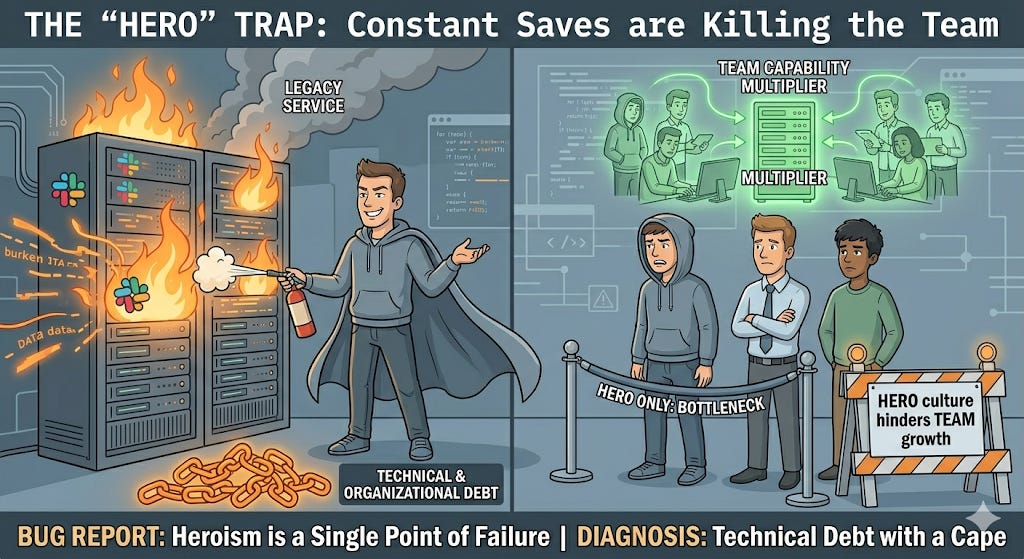
In my last post, we discussed the Bus Factor of 1. We established that being indispensable is a career failure. Now, we need to talk about the person who builds that failure. We need to talk about The Hero.
Many engineers suffer from a compulsion to “save the day.” They are the first to jump into every urgent chat. They pick up the 2:00 AM emergency call. They fix the legacy systems that everyone else is afraid to touch. They think they are demonstrating leadership. They think they are being helpful.
They are wrong. They are creating a system-wide bottleneck and calling it a contribution. Heroism is a bug. It is a sign that your processes are failing.
The Junior Logic Error
Early in your career, fixing every bug makes you a “great” Junior Engineer. You are demonstrating technical proficiency and high initiative. This is the baseline.
However, continuing this pattern as a senior resource is a fundamental misinterpretation of responsibility. The hero mentality creates a dangerous dependency. It signals a failure to understand the difference between individual execution and organizational leverage. A behavior rewarded at one level is toxic at the next. If you are still the primary firefighter as a Staff Engineer, you have failed to build a fireproof system. You are just a single point of failure with an ego.
Failure Modes: Misallocated Focus and Stunted Progress
For a senior leader, focusing on individual “saves” carries significant hidden costs.
Resource Conflicts. If the most expensive technical resource is always occupied with reactive problem-solving, strategic initiatives stall. Every hour a senior leader spends debugging a routine interface bug is an hour stolen from architectural design. This is a massive misallocation of compute power.
Stunted Team Development. By consistently stepping in, you deprive your colleagues of crucial learning opportunities. They never develop the muscle memory required to handle critical issues because you never let them touch the keyboard. You are not helping the team. You are keeping them in a permanent state of juniority.
The Feedback Loop Failure. When you fix a problem for someone else, the feedback loop for their own development is broken. They do not see the error. They do not learn the fix. They just see the problem “go away.” This ensures they will make the same mistake again. You are creating your own job security by making everyone else incompetent.
Post-Mortem: The “Weekend Warrior” Incident
I once watched an engineer “save” a product launch by rewiring the entire deployment pipeline over a single weekend.
The team was forty-eight hours from a critical release. The automated tests were failing. The team needed a stable environment. Instead of coaching the lead through the fix, the “hero” stayed up for thirty-six hours and rewrote the scripts from scratch. They pushed the fix at 4:00 AM on Monday. The release went out. They were praised.
Two weeks later, that engineer went on vacation. The pipeline broke again. Because no one else understood the new, “heroic” scripts, the entire organization was deadlocked for three days. The “save” on Sunday created a total system hang on Friday. This is not high performance. This is technical debt with a cape.
Proposed Fix: Moving from Execution to Multiplier
Career progression demands a shift from individual execution to systemic impact. Your value is no longer measured by the number of bugs you personally squash. It is measured by your ability to multiply the effectiveness of the entire team.
Delegation as Debugging. Identify opportunities to assign complex problems to junior colleagues. Provide the architectural constraints. Then, get out of the way. This builds their skills and reduces your own interrupt latency.
Root Cause Prevention. Instead of patching symptoms, invest time in identifying the systemic issues that cause the “fires.” This means improving the automated delivery systems or refactoring fragile components.
The “Why” Protocol. When you must intervene, do not just fix the code. Explain the system state that led to the failure. Your goal is to ensure you never have to fix that specific bug again.
Stop being a firefighter. Start building better fire prevention systems. Your role is to build capability, not to be the only person who knows where the extinguisher is.
Share Your Incident Reports
We all know a “Hero” who is actually a bottleneck. Perhaps you are that hero and you are wondering why you have not been promoted in three years. Tell me about the “Saves” that actually cost the company more than the original bug. Drop your logs in the comments.
System Library: Further Reading
Tools for moving from individual contributor to organizational leader.
The Book: The Staff Engineer’s Path by Tanya Reilly
The Takeaway: This is the manual for escaping the hero trap. It explicitly defines the shift from “doing the work” to “making the work better.”
The Article: The Glue People
The Logic: A look at the vital, often invisible work that actually keeps teams running. It challenges the idea that “heroic coding” is the only way to add value.
The Video: Mentorship + Sponsorship by Lara Hogan
The Gist: A guide on the difference between giving advice and giving opportunity. Essential for any “Hero” who wants to build a team that functions without their constant intervention.
System Status: Critical?
Writing about management is theory. Fixing it is engineering.
If your organization is suffering from hero-culture, high-latency leadership, or structural debt, I provide Strategic Debugging and Mentoring.
Review my operating parameters at weivco.com.