
The “Bus Factor” of 1: Why Indispensability is a Career Trap
Why being the only person who can do the job is the fastest way to stay in it forever.

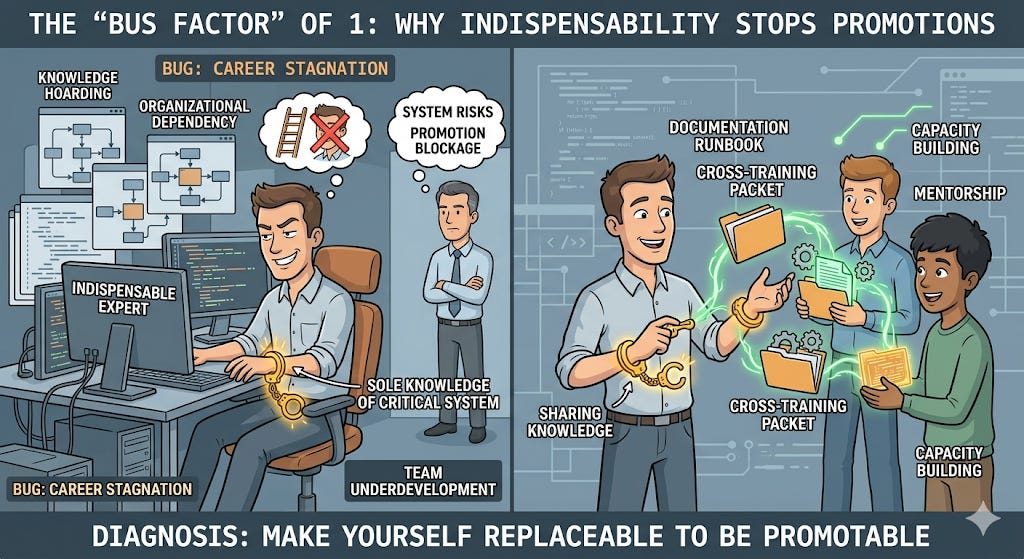
The “Bus Factor” is a simple risk metric. It asks: what is the minimum number of people who, if hit by a bus tomorrow, would cause the entire project to fail?
A bus factor of 1 is a disaster. It means one person holds all the critical knowledge. If they leave, the system stops. Many professionals mistake this for job security. They hoard information. They become the “sole expert” on a critical process. This is not a strategy. It is a career failure. It creates a bottleneck for the company and a ceiling for your own advancement.
The Indispensability Trap: Why Managers Won’t Move You
Being the only person who knows how to keep the lights on introduces severe vulnerabilities. This creates two specific failure modes for your career.
1. The Promotion Blockage.
Managers value stability above almost everything else. If promoting you creates an immediate, catastrophic hole in their operations, they will not promote you. They cannot afford to lose your current output. Replacing you becomes a high-cost, high-risk operation. It is easier to keep you exactly where you are. Your indispensability becomes a golden handcuff. You are too valuable in your current seat to ever move to a better one.
2. The Stagnation Loop.
If you are the only one who can do a specific task, you will always be the one doing it. This creates massive latency in your own skill development. While your peers are taking on new projects and learning new technologies, you are stuck maintaining the old machinery. You cannot take on new challenges because you cannot offload your current ones. Your career becomes a series of maintenance tasks for a system you should have outgrown years ago.
Team Underdevelopment: You Are the Bottleneck
Knowledge hoarding is a form of organizational debt. It prevents everyone else from growing. When complex problems always default to you, your teammates are left with trivial work. They never develop the muscle memory required to handle critical issues.
This creates a team of “helpers” rather than a team of “experts.” Overall capacity remains low because you refuse to distribute the load. True value is not found in being the only component. It is found in building a system that functions without you.
Proposed Fix: Start Replacing Yourself
Your goal is to be promotable. To be promotable, you must first be replaceable. You must systematically transfer your knowledge until the system no longer requires your direct intervention.
Standard Operating Procedures: Write it down. Every process, every debugging step, every decision matrix. Assume a new hire needs to understand your job within a week. This is how you standardize knowledge transfer.
The Rotation Protocol: Identify the tasks that only you perform. Force yourself to train at least one other person on them this month. Hand over the keys. If you can’t trust someone else to do the task, that is a failure in your teaching, not their ability.
The “Why” Mentorship: Stop giving people the answers. Start teaching them the thought process. Explain the logic behind the decision. This builds long-term capacity and reduces the number of times people need to interrupt your focus.
System Status: True Professional Value
Your value is not measured by the work you do. It is measured by the systems you build and the people you empower. The highest-performing leaders are those who have made themselves obsolete in their current roles.
This week, identify one critical task that only you can do. Document it. Train a successor. Make yourself replaceable.
Share Your Tales of the “Indispensable”
I want to hear about the “Bobs” of your organization. Who is the person holding the entire company hostage because they are the only ones who know where the bodies are buried? How has that stopped their career or your team’s growth? Post your stories in the comments.
System Library: Further Reading
Tools for knowledge distribution and succession planning.
The Book: The Phoenix Project by Gene Kim, Kevin Behr, and George Spafford
The Takeaway: Read about the character “Brent.” He is the classic example of an indispensable engineer who becomes the company’s biggest bottleneck. This is a manual on how to fix that behavior.
The Concept: The Bus Factor
The Logic: A deeper look at the mathematical risk of concentrated knowledge. Understanding this helps you frame your “replacement” as a risk-mitigation strategy to your manager.
The Video: How to Delegate Effectively
The Gist: A tactical guide on how to hand over responsibilities without losing quality. It teaches you how to move from “doing” to “leading.”
System Status: Critical?
Talking about management is theory. Fixing it is engineering.
If your organization is suffering from knowledge silos, promotion blockages, or structural decay, I provide Strategic Analysis and Mentoring.
Review my operating parameters at weivco.com.