
The Ambiguous ACK
"Yes" confirms receipt. It does not commit the transaction.

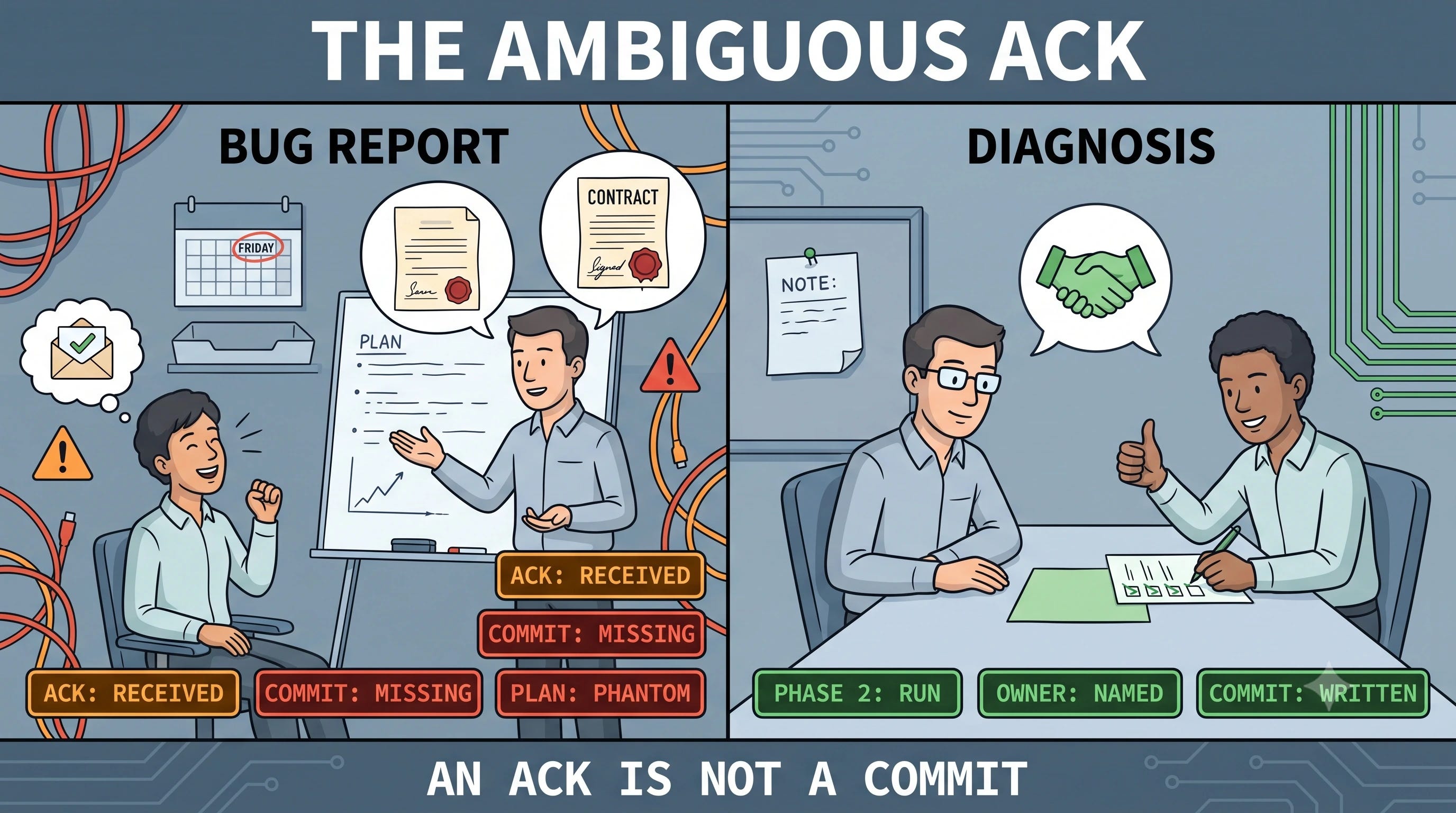
You asked for the fix by Friday. He said yes. He said it clearly, twice, nodding. Friday came, and nothing came with it. You are now telling people he lied to you, and you are wrong. Nobody lied. You two were running different protocols, and you mistook an acknowledgment for a commit.
This is the Foreign Engineer’s Field Guide, translation lane. This entry is about the most expensive three-letter word in cross-cultural engineering.
ACK Is Not Commit
Every network engineer knows the difference. An ACK says one thing: I received your packet. It does not say I agree, I will act, or the data is safe on disk. Confusing receipt with commitment is a beginner error in protocol design, and entire careers of misery come from making the same error with people.
On low-context grids, “yes” is overloaded toward commitment. Say yes to a deadline in an American meeting and you have signed something. Deliver nothing and you are a person who breaks promises. On high-context grids, “yes” is overloaded toward acknowledgment. It means: I heard you, I respect you, I am taking this seriously, the conversation continues. Whether the thing will happen by Friday is a separate question that was never actually answered, and everyone raised on that grid knows it was never answered.
Neither protocol is broken. One optimizes for explicit contracts, the other for preserved relationships. But they do not interoperate, and the packet you keep dropping is the difference between “I hear you” and “I will.”
Reading Their Yes
First failure direction: you are the one collecting yeses. You run the planning meeting, everyone agrees to everything, and you walk out with a project plan built on phantom commitments. Three weeks later the plan collapses and you conclude the team is unreliable or dishonest. They are neither. You collected ACKs and booked them as commits.
The refusal channel works the same way. On high-context grids, “no” is expensive, so it ships encoded: “we will consider it,” “that would be difficult,” “let us study this further.” Native speakers decode these correctly most of the time. You decode them never, wait for the study that will never arrive, and lose a quarter. The decoding itself is the step-up conversion from the adapter post. Run the adapter.
Sending Your Yes
Second direction, the one that damages your reputation instead of your plan. You come from a grid where agreement in a meeting is social lubrication, and you say yes the way you always have: yes, I understand, yes, good idea, yes, we should do that. The local grid writes every one of those down as a signed contract. Then some of them do not happen, because half of them were never promises, and the grid quietly reclassifies you as someone whose word means nothing.
This one is brutal because your intent was respect. You were maintaining the relationship, exactly as trained. The local protocol has no type for that packet, so it parses it as the nearest one it knows: commitment. Your courtesy becomes a contract, and your normal behavior becomes a breach.
Run Two-Phase Commit
The fix is a protocol engineers already trust: never treat a first yes as final, in either direction. Distributed systems formalized this decades ago as two-phase commit. Phase one, the coordinator sends the proposal and collects explicit votes: each participant states, deliberately, whether it can commit. Phase two, only after every vote is in, the commit is recorded and broadcast. The vote is a separate act. Receipt of the proposal counts for nothing.
Run it on people. The meeting is the proposal broadcast, and the nods it produces are ACKs: warm, useful, and worth nothing on a delivery chart. The phase-one vote is the explicit question, and it names three things: the concrete deliverable, the date, and the owner. “So, you will have the migration tested by Friday, and you own it?” Phase two is the commit record: restate it in writing afterward, especially on any grid where relationships outrank contracts. Not as a trap. As the log entry where the real answer arrives, because a correction in a reply costs less face than a refusal in a room. On the grid, unlike in the database, the commit record is also the last call for aborts. And if the local hierarchy will not let you interrogate a superior out loud, the written restatement is the only vote you can call. Use it.
One more property of the protocol, and here it is a feature: two-phase commit blocks. A participant who never answers wedges the whole transaction, so treat a non-answer past the deadline as an abort, not as a vote still pending. Silence is not a maybe. It is a no that has not filed its paperwork.
And type your own yes before you send it. You know the difference between your ACKs and your commits. The room does not. Say which one it is: “I hear you, let me check the schedule before I promise” or “yes, committed, Friday.” The first sentence feels weaker than a warm yes. It is worth more, because it is the only currency the local grid accepts at face value.
If you run the team, one more duty: make “no” cheap. People hand out empty yeses in exact proportion to what a real no costs them. If refusing you is expensive, you will get ACKs forever, from every culture, and you will deserve every collapsed plan they produce.
The Request
Pull up the three yeses your current plan is actually resting on. For each one, answer honestly: did you receive a commit, with a deliverable, a date, and an owner said out loud, or did you receive an ACK and do the rest of the work yourself, in your head? Re-run phase two on the load-bearing ones this week. Expect at least one to dissolve on contact. Better now than on Friday.
Then tell me in the comments about the most expensive ACK you ever booked as a commit, or the yes you sent as courtesy that got filed as a contract. And post your grid’s favorite encoded no. The decode table grows one entry at a time.
System Library
The Talk: How Culture Drives Behaviours by Julien S. Bourrelle
A scientist’s take on why the same behavior decodes differently across cultures, and why you misread the signals even when you are trying not to. Watch it for the mechanism behind the yes that was never a promise: perception runs through the grid you were raised on.
The Concept: Two-Phase Commit
The distributed-systems protocol this post steals: no participant commits until every participant has explicitly voted to commit, and receipt of the proposal is never a vote. Run it on humans and agreements that never existed stop reaching production.
The Field Manual: Getting to Yes by Fisher and Ury
The negotiation classic on separating people from positions and building agreements that are explicit instead of atmospheric. Read it as the application layer: how to extract a real commitment without making the other side pay for honesty.
System Status
Theory is for brochures. Engineering is for survival. If your project plans keep collapsing on yeses that were never commitments, or your own word keeps getting booked as promises you never made, I provide Strategic Debugging and Mentoring. Review the operating parameters at weivco.com.
Elsewhere: I write about building software with AI at The Old Man and the AI, and I build Fractbox, a browser-based 3D fractal engine.