
Saying No: The Circuit Breaker
Implementing Backpressure.

BODY (paste below the subtitle; title + subtitle go in their own Substack fields)
Saying no feels like a political problem. You worry about the raised eyebrow, the manager who logs it as “not a team player,” the colleague you are letting down. So you say yes. Yes to the extra project, yes to the unscheduled review, yes to the “quick favor” that is neither quick nor a favor.
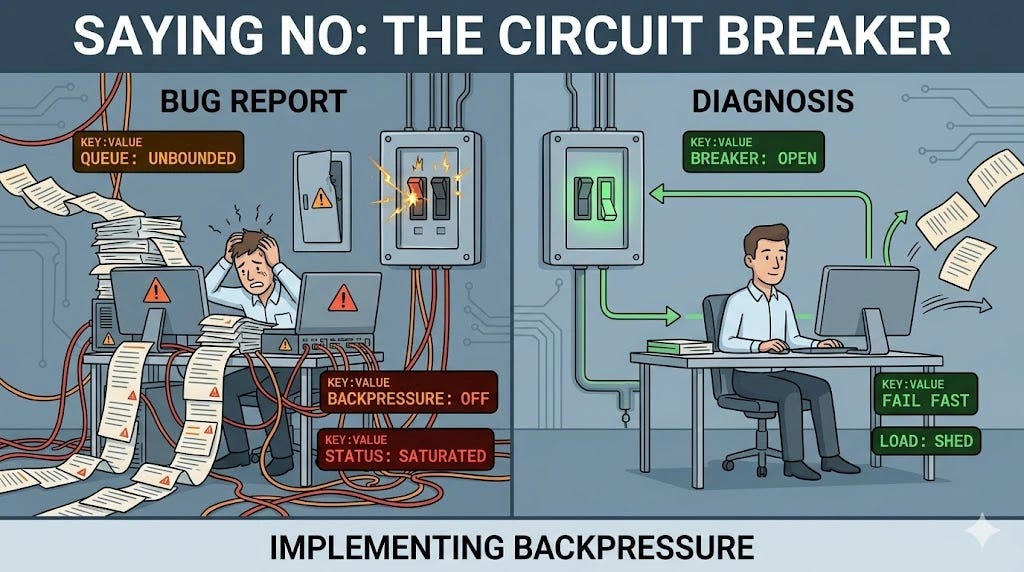
This is not a courage problem. It is a flow-control problem. Your inability to say no means your system has no backpressure. And a system with no backpressure does not run faster. It saturates, and then it collapses. This is sub-system 6 of the Active Balance arc, and it is the one most of you have disabled on purpose.
The Unbounded Queue
Every yes is an enqueue. When you accept work faster than you can clear it, the queue does not politely hold steady. It grows without bound.
People imagine the cost of saying yes is a few late nights. The real cost is queueing theory. Latency equals queue depth divided by throughput. As the queue grows, the wait time on everything in it grows with it. You do not miss one deadline. You miss all of them. First by a little, then by a lot. The work you accepted to look helpful is the exact work that makes you unreliable on everything else you already owed.
An accepted task is not a finished task. It is a promise with no capacity allocated behind it. Saying yes to everything does not clear the board. It converts an honest, early no into a silent, late failure. The work does not disappear when you accept it. It rots in your buffer and takes the rest of your commitments down with it.
Backpressure Is Not Insubordination
In a healthy distributed system, a consumer that cannot keep up signals the producer to slow down. That signal is backpressure. It is not the consumer being difficult. It is the consumer being honest about its capacity.
Remove the signal and throughput does not improve. The producer keeps shoving messages at a saturated consumer. Buffers fill. Then you get dropped packets, timeouts, and a cascade that takes down services that were perfectly healthy a minute ago. A team that cannot report that it is full is a service with its flow control switched off.
“No” is backpressure. “Not this sprint” is backpressure. “Yes, if we cut the migration” is backpressure. This is the polite, continuous form of flow control. You report your capacity, and a well-behaved producer throttles to match.
There is one catch, and it is the whole problem. Backpressure only works if the producer honors it. It assumes cooperation. The producer in your system, the manager with a roadmap and the stakeholder with a deadline, is frequently not cooperative. You signal that you are full. They enqueue anyway. A polite signal into a producer that ignores it is not flow control. It is just noise you emit on the way to saturation.
The Circuit Breaker
So a polite no is not enough. When the producer ignores backpressure, you need a mechanism that does not ask permission. That mechanism is the circuit breaker.
A breaker sits in front of a service. When load crosses a threshold, it trips open and rejects incoming requests immediately, on its own authority, before they pile up. After a cool-down it goes half-open, lets a trickle through, and closes again only once you have actually recovered. Note the trigger: this breaker trips on your saturation, not on someone else’s failure. It is the hard, unilateral version of the same no. It is backpressure that does not require consent.
The logic is counterintuitive: failing fast is kinder than failing slow. A fast no lets the requester reroute. They can find another owner, cut scope, or escalate while they still have runway. A slow yes that turns into a missed deadline three weeks later strands them with no options. You did not help them by accepting. You took their work hostage and delivered the bad news too late to act on.
Tripping the breaker on purpose is the entire point. The alternative is the breaker tripping by itself, with no threshold and no warning. That failure mode has a different name. Burnout is a circuit breaker you never configured. It does not trip when you decide. It trips when the hardware melts, and it takes the queue with it.
Tuning the Threshold
A breaker that never trips is not loyalty. It is a fire waiting for an ignition source. But a breaker that trips on everything is useless too. The whole skill is in the threshold.
Shed load by priority, not at random. Know your one or two real obligations and protect their capacity without apology. Everything else is sheddable, and pretending otherwise is how the critical work starves.
Make the rejection explicit and cheap. A good no is a returned error code, not a silent drop. “I can take this, but the release slips a week. Your call.” That is not a refusal. It is exposing the tradeoff that was always there and handing ownership of it back to the requester. You are not the bottleneck. The capacity is the bottleneck. Your job is to make that visible, early, instead of absorbing it in silence until every commitment times out at once.
The Request
Measure your queue depth. List everything you have said yes to that is not yet done. Find the one commitment you accepted to avoid an awkward conversation, the one quietly making everything else run late. Trip the breaker on it this week. Decline it, renegotiate it, or surface the tradeoff in plain words. Return an error code instead of letting it time out silently. Do it now, while the requester still has time to route around you. A no they can act on today is worth more than a yes that fails them next month.
Then tell me in the comments where your breaker is welded shut. What is the one commitment you keep accepting that you know is saturating the queue, and what is it starving while you protect it? The specific failure mode is more useful to the rest of us than the theory.
System Library
The Talk: Stop Rate Limiting! Capacity Management Done Right by Jon Moore
Forty minutes that derive, straight from Little’s Law, why accepting every request and rate-limiting after the fact is the wrong model, and why bounding concurrency is the backpressure that actually holds. This is the math behind the breaker.
The Pattern: CircuitBreaker by Martin Fowler
The canonical definition of the breaker states. It is the precise argument for why a tripped breaker protects the system instead of betraying it, and why the early, deliberate no is the safe one.
The Field Manual: Release It! by Michael Nygard
The book that put circuit breakers and bulkheads into mainstream practice. Its stability patterns are a direct map of how overload cascades through any system, human or machine, that refuses to shed load.
System Status
Writing about management is theory. Fixing it is engineering. If your team is redlining, dropping work silently, or one missed no away from a cascade, I provide Strategic Debugging and Mentoring. Review the operating parameters at weivco.com.