
Pessimism: Error-First by Default
Why your honest "this is broken" reads as negativity, and why their "great progress" hides the outage.

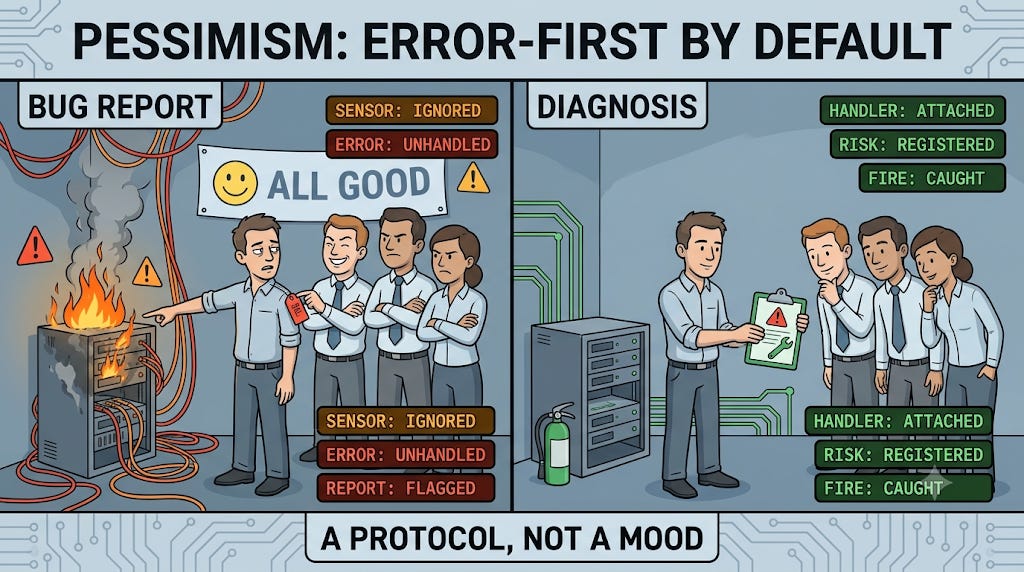
Every relocation guide tells you the same thing. Americans are positive. Smile more. Complain less. True, and useless, because it treats your so-called negativity as a personality defect to fix. It is not a defect. It is a calling convention, and you are about to spend years being punished for using the wrong one.
This is the second entry in the Foreign Engineer’s Field Guide, translation lane. The Jokes post covered the payload that decompresses wrong. This one covers something deeper: which channel carries the errors at all.
Error-First Is a Protocol, Not a Mood
Some languages return the error first. The convention forces you to look at the failure before you touch the payload. Nobody calls this pessimism. It is defensive programming, and it comes from environments where things fail often and failure is expensive.
Some cultures compile people the same way. If you grew up on a grid where the plan changed weekly, the institutions lied, and the optimist was the one who got hurt, you learned to return the error first. Status report opens with what is broken. “How are you” gets an actual answer, including the medical details. The risk list comes before the demo. This is not gloom. It is the protocol of a system that assumes failure because failure was the common case.
Then you move to a success-first grid. There, the default return value is “great.” Errors are exceptions: thrown rarely, caught privately, wrapped in three layers of enthusiasm before anyone throws them at all. Neither protocol is wrong. But they do not interoperate, and both directions fail on contact.
Your Output: The Defect Report Parsed as an Attitude
First failure direction. You transmit your normal, accurate status: the deadline is unrealistic, the dependency is late, the design has a hole. At home this made you the reliable one. Here it gets parsed through the success-first decoder, and the decoder does not have a slot for “honest error report.” It files your signal under morale problem.
Now your performance review says “not a team player.” You out-engineer the room and get routed around, because every plan you touch, you touch with a list of the ways it dies. You were doing risk analysis. The grid heard complaining. Being right does not save you; it never does.
Note what actually failed. Not your judgment. The framing byte. On a success-first grid, an error without a proposed handler is read as an attack on the plan. An error with a handler attached is read as leadership. Same defect, same accuracy. “This breaks under load” is negativity. “This breaks under load, here is the cheap fix” is initiative. You were shipping raw errors and letting them decode however they landed.
Your Input: The Outage Buried in Good News
Second direction, the one nobody warns you about. You cannot parse their channel either.
On a success-first grid, errors ship out-of-band, wrapped in padding. “Great progress, a few challenges around the timeline” is not great progress. It is a slipping project, and “a few challenges” is the entire message. “We should keep an eye on that” means it is already on fire. You hear the enthusiasm, discard the qualifier, and walk out thinking things are fine. Then the project dies and everyone but you saw it coming, because everyone but you could read the local error encoding.
Worse, you start distrusting them wholesale. All this positivity looks like delusion or dishonesty to an error-first receiver, so you write off the entire signal. That is the mistake. The errors are all there. They are just transmitted on the low-order bits, and you need the step-up adapter to recover them.
Complaint Is a Handshake
There is a third layer, and it is the one that stings. On your home grid, mutual complaint is not venting. It is the handshake protocol. Two engineers trading failures over coffee are not being miserable. They are exchanging proof of trust: I show you my real state, you show me yours, now we are peers. Solidarity through shared defect logs.
Run that handshake on a success-first grid and it does not bond. It contaminates. Your opening move, the honest grumble that started every friendship you have, reads as toxicity, and people quietly route around you. Meanwhile their handshake, relentless small positivity, reads to you as fake, so you refuse to complete it. Both sides withdraw, each convinced the other is being false. Nobody was false. The handshakes just do not match.
Do Not Delete Your Error Handler
The standard advice, become positive, is the recompile-yourself error this arc keeps warning about. If you force yourself to return “great” by default, you have not adapted. You have disabled the most valuable thing you ship: a working failure detector in a room that has none. Teams on success-first grids are systematically blind to their own risk. Your pessimism is not the bug. Undelivered, it is a wasted sensor.
Localize instead. Three moves.
Attach a handler to every error. Before you report the defect, staple the mitigation to it. Not because your raw report was wrong, but because the local decoder needs the handler to classify the packet as help instead of hostility.
Use the sanctioned containers. Success-first grids have designated slots where pessimism is legal: the pre-mortem, the risk register, the failure-mode review. Inside the container, your error-first instinct is a superpower with a job title. Outside it, the same sentences are a morale problem. Move the payload, keep the label.
Re-parse their good news. Take every status you receive and re-read it for the qualifier. The sentence after “overall this is going really well” is the actual status report. Decode the padding; that is where they keep the errors.
And keep one channel at native voltage. Your error-first people, the ones who share the protocol, still need the real handshake. Do not pad your signals to them; that is how they lose the ability to read you.
The Request
This week, take the defect report you are already sitting on, the one you have raised twice and been tagged as negative for. Do not soften the defect. Staple a handler to it: the mitigation, the cheap test, the fallback. Ship it once more in that format and watch how differently the same data lands.
Then run the input side. Pull up the last three “going great” updates you received and re-parse each one for the buried qualifier. At least one of them was an outage report. Find it.
Tell me in the comments which cost you more so far: the honest report that got you labeled, or the cheerful update you failed to decode. And if you have a phrase from your local grid that took you years to translate, post it. The decode table helps everyone.
System Library
The Talk: Smile or Die: The Dangers of Positive Thinking by Barbara Ehrenreich
The RSA Animate of Ehrenreich’s argument that mandatory optimism is not harmless, it deletes the error channel: from mortgage risk nobody could report upward to layoffs rebranded as opportunity. Watch it to understand the grid you are transmitting into, and why it needs your sensor more than it wants it.
The Concept: Defensive Programming
The software discipline this post steals from: assume invalid input, check the error before the payload, design for the failure case. Nobody calls a null check a bad attitude. That is the reframe, named precisely.
The Field Manual: The Positive Power of Negative Thinking by Julie Norem
Norem’s research on defensive pessimism: people who perform best by imagining what goes wrong first, and who get worse when forced to cheer up. The evidence that your error-first default is a working strategy, not a disorder, and that deleting it costs real performance.
System Status
Theory is for brochures. Engineering is for survival. If your most accurate status reports keep getting filed as a bad attitude, or projects around you keep dying of risks that were audible only to you, I provide Strategic Debugging and Mentoring. Review the operating parameters at weivco.com.
Elsewhere: I write about building software with AI at The Old Man and the AI, and I build Fractbox, a browser-based 3D fractal engine.