
Networking for People Who Would Rather Be Coding
How to build influence when you have the social battery of an iPhone 4.

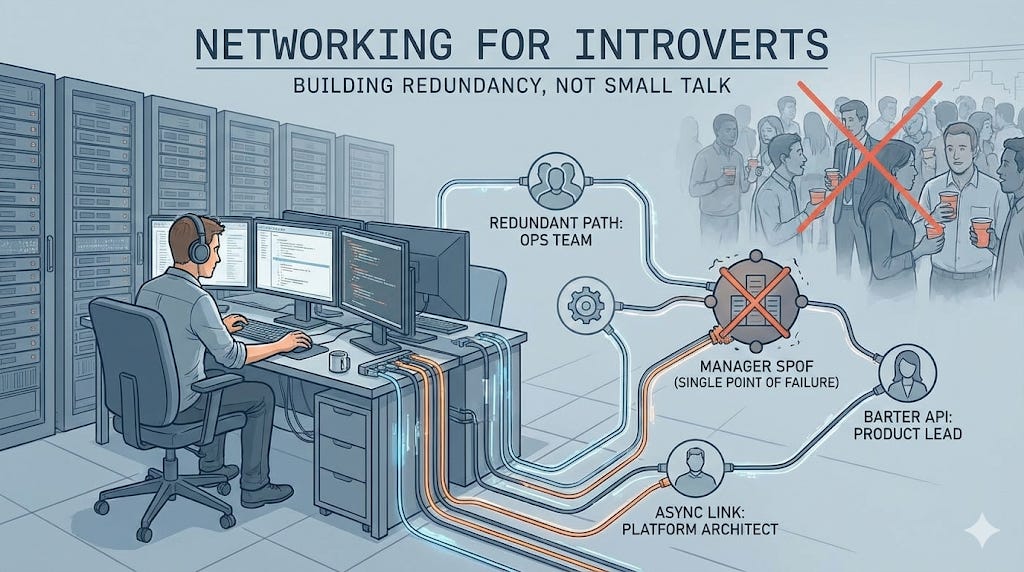
Let’s be honest: If you are an introvert, “networking” could be the hardest part of the job.
Especially when it involves standing in a room with bad acoustics, drinking warm white wine from a plastic cup, and trying to think of a second question to ask about someone’s golden retriever.
For most engineers, this is torture. We like deterministic systems. People are non-deterministic, messy, and often have very poor documentation.
But after 20 years in Big Tech, I have to admit a painful truth: The code does not speak for itself.
No matter how brilliant your architecture is, if no one outside your immediate team knows about it, it might as well not exist. Visibility isn’t vanity - it’s infrastructure.
If you want your projects to succeed, get promoted, or if you just want to survive the next reorg, you need to build out a network. But you don’t have to do it like a salesperson. You can do it like an engineer.
Here’s how:
1. Networking is just “Redundancy” (Fault Tolerance)
I don’t network because I want more friends. I have enough friends (I have three, which is plenty).
I network because I understand System Reliability.
If the only person in the company who knows your value is your manager, you have a Single Point of Failure (SPOF).
Your manager could get fired or “re-orged” into the basement.
Your manager might quit to join a crypto (if you are reading this in the past) or an AI startup.
Your manager might decide that having you as their report is not the best idea in the world.
If your manager is your only connection to the power grid, you are one bad meeting away from a blackout. You need redundant routing paths. You need 3-5 other people who know your API endpoints (what you are good at) so that when the SPOF fails, the packets still get through.
2. The “Async” Loophole (Background Processing)
Extroverts network synchronously (talking). This requires high bandwidth and low latency, which drains my battery immediately.
The loophole is Asynchronous Networking.
I realized I could be much more “charming” in a design doc than in person, mostly because Google Docs lets me edit out the heavy sighs.
The Strategy: Be useful in public. Write the post-mortem that actually fixes the root cause. Write the migration guide that saves another team 20 hours.
The Result: People start to know your name not because you made small talk, but because you solved their problem while you were asleep.
This is high-leverage networking. You broadcast competence to 100 people without making eye contact with any of them.
3. Strategic Silence (Passive Polling)
Eventually, you have to talk to humans. This is where engineers usually fail because we try to be “interesting.”
The secret is that you don’t need to be interesting. You just need to be an audience.
A lot of people in corporate America are desperate to be heard. They are starving for someone to just sit there and nod while they complain about the legacy codebase.
The Tactic: Schedule a 15-minute sync. Ask one question: “What is the biggest pain point in your backlog right now?”
The Execution: Then, stop talking. Look concerned. Maybe write something down.
The Outcome: They will leave the meeting thinking you are a brilliant conversationalist, even if you only said 12 words.
You save your energy; they feel validated. It’s a win-win.
4. The “Barter” System (API Contracts)
The part of networking that feels “fake” is the pretense of friendship. We pretend we want to grab coffee because we enjoy the company, when really we just need budget approval.
I find it easier to drop the pretense.
It is actually more respectful to be transactional, provided you are polite about it. View your colleagues not as “family,” but as dependencies in a distributed system.
Don’t say: “Hey, how was your weekend? Crazy weather, huh? Anyway...”
Do say: “I know you’re swamped. I need X to unblock my team. If you help me with this, I can lend you an engineer to help with your migration next quarter.”
This isn’t cold; it’s professional. It respects their time and intelligence. It acknowledges that we are all just trying to ship something and go home.
Summary: The Practical Reality
Networking doesn’t require you to be charismatic or outgoing. It requires you to be strategic and consistent.
The best networkers I know aren’t the ones who work a room. They’re the ones who:
Show up reliably to a small number of meetings.
Write documents that people forward to others.
Build credibility by solving visible problems.
Follow up when they promise something.
It’s the same discipline you’d apply to a codebase: think in terms of scalability, avoid single points of failure, and optimize for long-term maintainability rather than short-term performance.
If you’d like to network with me, drop a comment below. I love a good discussion!
System Library: Further Reading
If you want to debug your social graph:
The Book: Never Split the Difference by Chris Voss
The Engineering Angle: It teaches negotiation, but it’s really about understanding human protocol buffers.
The Concept: The Strength of Weak Ties (Mark Granovetter)
The Engineering Angle: Your close friends (Strong Ties) are your local cache. Acquaintances (Weak Ties) are the internet. You need the internet to find new jobs.
Related Logic: “Three Magic Words“ (Previous Post)
The Gist: The art of saying uncomfortable things without destroying relationships.
System Status: Critical?
Writing about management is theory. Fixing it is engineering.
If your organization is suffering from high latency, packet loss in communication, or structural debt, I provide Strategic Debugging and Leadership Mentoring.
I help you refactor your team like you refactor your code.
Review my operating parameters at weivco.com.