
Jokes: The Untranslatable Payload
Why the humor that bonds your home team gets you flagged abroad.

Every guide to working abroad gives you the same line. Humor does not translate, so be careful. True, and useless. It tells you to stop without telling you why, so the first time a joke that has worked your entire life lands in dead silence, you have no idea what just broke.
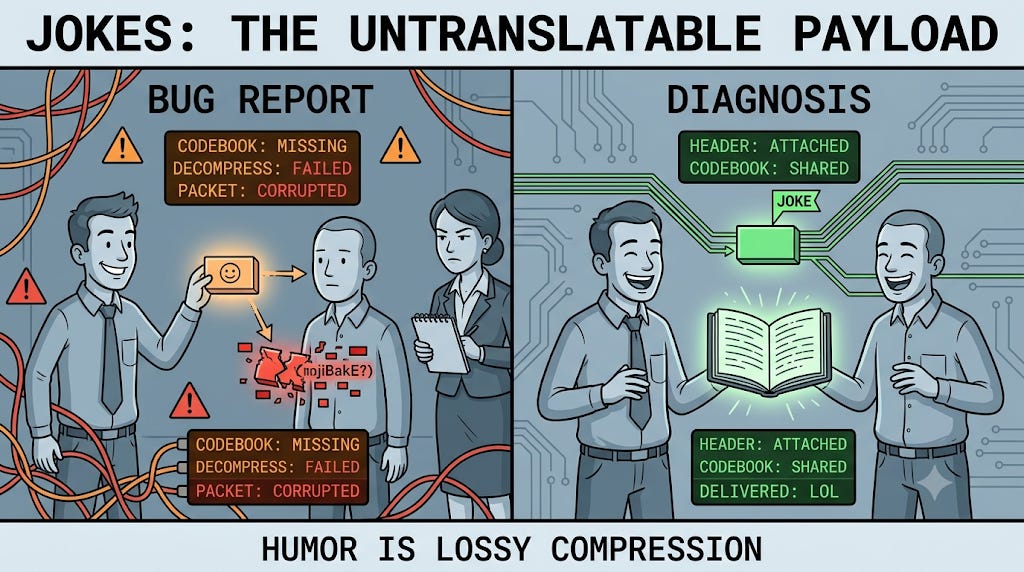
Here is what broke. A joke is a compression algorithm, and you just shipped a payload to a machine that does not have your codebook. This is the first entry in the Foreign Engineer’s Field Guide, the translation lane, and it is the layer that fails fastest and most visibly.
Humor Is Lossy Compression
A joke is the most compressed message you will ever send. A four-second one-liner encodes a whole scene: a social convention, a literal-versus-figurative flip, a shared assumption about how people behave. The receiver decompresses all of it instantly, using a codebook of references both of you already hold.
That codebook is the entire point. Humor is high-context: the payload is not in the words, it is in the gap between the words and what both people already know. Strip the shared context and the words alone carry almost nothing. This is why explaining a joke kills it. You are manually decompressing a packet that was built to decompress on its own, and the overhead destroys the signal.
Two Ways Decompression Fails
When you send a joke across a cultural boundary, one of two things happens, and they are not equally survivable.
The first is the dropped packet. The receiver does not have the codebook, decompression fails, and you get the blank stare. This is embarrassing but cheap. The joke landed as noise, nobody was harmed, you move on.
The second is the corrupted decompress, and this is the expensive one. The receiver has a different codebook, so the packet rebuilds into a payload you never sent. Your dark, fatalistic, self-aware joke, the one that bonds your team back home, gets reconstructed on the local grid as genuine pessimism, hostility, or an HR-reportable statement. You did not just fail to be funny. You transmitted a message you never wrote, and now you are explaining yourself to someone holding a notepad.
Deadpan Ships Without a Header
Some delivery styles make the failure worse by stripping out the one piece of metadata the receiver needs: the flag that says “this is a joke.”
In high-context cultures, deadpan and sarcasm are prestige formats. The humor is precisely in the receiver inferring the inversion themselves, with no laugh track, no wink, no tonal cue. You say the opposite of what you mean in a flat voice and trust them to invert it. That trust is the joke.
Send that to a low-context grid and the inversion never happens. They do not supply the flag, because their protocol expects intent to be explicit, so they take the literal payload. “Oh good, another reorg, exactly what we needed,” said flat, lands as either enthusiasm or insubordination, never as the joke it was. The signal needed a header your audience does not generate on its own.
Do Not Stop Being Funny
The usual advice ends here: just stop joking. That is the recompile-yourself error this whole arc warns against. Humor is not decoration. It is one of the highest-bandwidth bonding tools you have, the thing that turns a group of coworkers into a team. Deleting it to be safe is a real loss, and it makes you duller and more forgettable in the exact rooms where you can afford to be neither.
You localize instead. Three moves.
Match the compression to the codebook. With your own people, who share your references, run the dark high-compression material at full rate. With a new or mixed audience, drop to low-compression humor that needs no shared context: observational, situational, and above all self-deprecating. You as the target travels almost everywhere, because nobody else has to share a codebook to enjoy watching you take the hit.
Attach the header when the grid will not generate it. In low-context settings, flag the packet. A small tonal shift, a visible signal that the inversion is intended. It feels clumsy and it costs you the elegance of deadpan. It also stops the corrupted decompress that ends in a notepad.
Learn to read theirs. This is the step-up direction. The local grid has its own humor, with its own codebook, and the fastest way into a team is laughing at the right thing at the right moment. Pay attention to what they find funny before you decide their culture has no sense of humor. Usually it has a sense of humor you have not decompressed yet.
The Request
Find the one joke you reliably reach for, the move that has bonded every team you have been on, the one that has gone quiet or strange since you moved. You know the one. Work out what is in its codebook: which reference, which shared assumption, which expectation of deadpan it depends on. Then decide, on purpose, whether to attach a header to it or to hold it for the audience that already has the dictionary. Pick one joke. Do not delete it. Localize it.
Then tell me in the comments about the joke that bombed hardest in a new culture, and what you eventually worked out it depended on. The specific dead silence is more instructive to the rest of us than the theory.
System Library
The Talk: Why We Laugh by Sophie Scott
The neuroscientist’s case that laughter is mostly not about jokes at all. It is a social signal, an animal call for bonding, and you laugh far more with other people than alone. Watch it to see why losing your humor abroad costs you the bonding channel, not just the punchlines.
The Concept: Benign Violation Theory
The leading account of what makes something funny: a violation that the receiver also reads as benign. This is the exact mechanism that breaks across cultures. The violation survives the trip; whether it still reads as benign depends entirely on the local codebook, and when it does not, the joke rebuilds as an attack.
The Field Manual: The Humor Code by Peter McGraw and Joel Warner
A researcher and a journalist travel the world testing what is funny where. Read it as field evidence that the codebook is real, specific, and does not ship with the joke.
System Status
Theory is for brochures. Engineering is for survival. If you are a strong engineer whose signal keeps getting corrupted in translation, the feedback that misfires, the humor that alarms, the rooms that stay closed, I provide Strategic Debugging and Mentoring. Review the operating parameters at weivco.com.
Elsewhere: I write about building software with AI at The Old Man and the AI, and I build Fractbox, a browser-based 3D fractal engine.