
You Are Not Listening, You Are Just Buffering
Why the most senior skill in engineering is admitting you might be wrong.

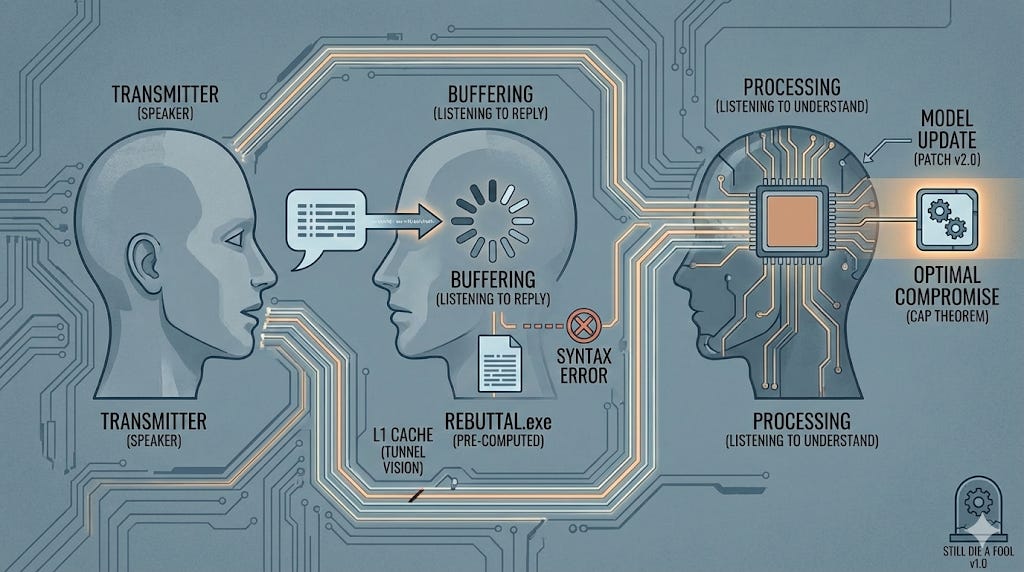
In a previous post, I mentioned the importance of “Steel-manning” - building up your discussion partner’s argument before you point out the problems with it.
This requires a skill that is painfully rare in corporate America: Listening to understand, rather than listening to reply.
We have all been in that meeting. Someone is speaking, and you are not actually processing their data. You are just waiting for a gap in the audio stream so you can inject your pre-computed rebuttal.
You are buffering.
This is a junior engineer mindset. It assumes that the goal of the conversation is to “win.” But as you move up the stack, the goal shifts. The goal is no longer to be right; the goal is to ship the right thing.
The Bug of “Focus”
We are trained to view “Focus” as a virtue. In coding, it is. You need to load the entire context into your L1 cache and block out the world.
But in architecture and leadership, Focus is a liability.
Focus creates a tunnel. It filters out signals that don’t match your current hypothesis.
How many times have you spent four hours debugging a complex race condition, convinced the issue was in the database locking logic? And then a colleague walks past, glances at your screen, and asks, “Why is there an extra ‘#’ on line 42?”
You were so focused on your complex theory that you couldn’t see the syntax error staring you in the face.
Debates are the same. If you are focused entirely on defending your solution, you will miss the “extra #” in your logic. You need that colleague’s perspective not to “beat” you, but to debug you.
The Geometry of Compromise
Engineering is the science of trade-offs. We live inside the Iron Triangle (Good, Fast, Cheap - pick two). We live with the CAP theorem (Consistency, Availability, Partition Tolerance - pick two).
There are no perfect solutions, only reasonable compromises.
If you are listening only to defend your corner of the triangle, you will miss the optimal solution that lies in the middle.
You are fighting for Consistency.
They are fighting for Availability.
If you actually listen to understand why they need Availability, you might realize that “Eventual Consistency” is a valid path that satisfies both constraints.
If you listen only to reply, you stay stuck in your corner.
The Joy of Being Wrong
The hallmark of a senior leader is the ability to change their mind without their ego getting bruised.
When you listen to understand, you open yourself up to the possibility that your base assumptions were wrong. This should not feel like a defeat. It should feel like a software update.
You just downloaded new data. Your internal model is now more accurate than it was five minutes ago. That is a victory.
The Summary
Stop buffering. Stop waiting for your turn to speak. When someone disagrees with you, suppress the urge to correct them. Instead, assume they see a “syntax error” that you are missing.
My late grandaunt had a saying that sums this up better than any management book:
“You learn something new every day, and you still die a fool.”
The goal isn’t to be the smartest person in the room. The goal is to be a slightly less foolish person than you were yesterday.
Please share your experiences in the comments. Have you caught yourself buffering? How did you communicate with colleagues that were?
System Library: Further Debugging
Data sources for this post.
The Concept: Steelmanning
The Source: Conceptually.org
The Engineering Angle: Most people “Strawman” (attack a weak, compressed version of the argument). “Steelmanning” is the practice of fixing your opponent’s bugs before you attack their logic. If you can’t argue their side better than they can, you don’t understand the problem class.
The Book: Thinking, Fast and Slow by Daniel Kahneman
The Engineering Angle: The technical manual for your brain’s two operating modes. “System 1” is your cached, low-latency intuition (prone to bugs). “System 2” is your high-compute, expensive analytical processor. This book teaches you how to stop running critical decisions on the buggy System 1 thread.
The Video: “5 Ways to Listen Better”
The Gist: We are losing our listening bandwidth.
Watch: 5 ways to listen better
System Status: Critical?
Writing about management is theory. Fixing it is engineering.
If your organization is suffering from high latency, packet loss in communication, or structural debt, I provide “Strategic Debugging” and “Leadership Mentoring.”
Review my operating parameters at weivco.com.
Enjoyed this one, as we say in our meditation group, replace judgement with curiosity. And I can relate to focus as sometimes I spend hours on a one sheet design moving a block of text around with shadow boxes when I could be actually meeting or talking about it solution. Hah.