
You Are Not an Oversharer; You’re Just Using the Wrong Protocol
Why “How are you?” is a trap for direct cultures, and how to stop crashing the conversation.

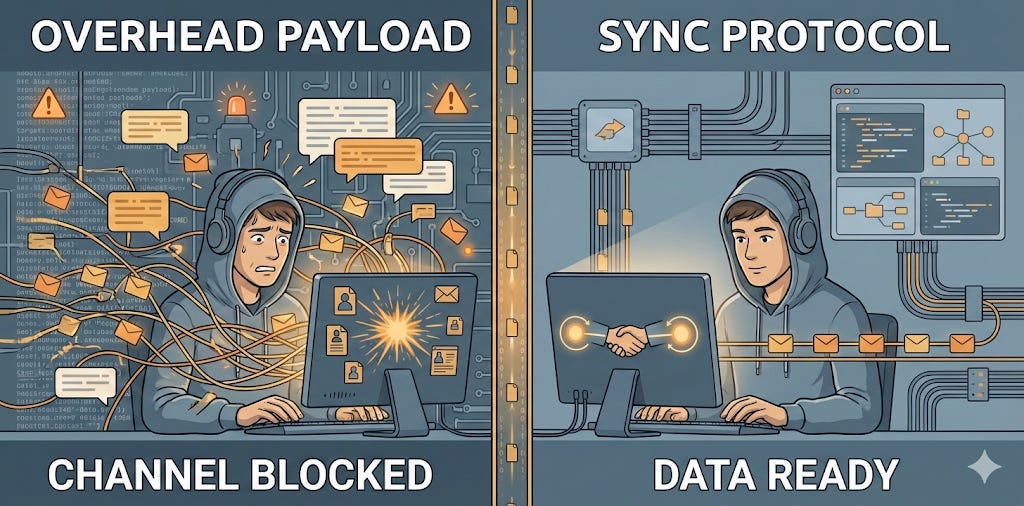
If you come from a culture where words have literal meanings—places like Serbia, Germany, or Israel—the American “How are you?” is a recurring nightmare.
In Belgrade, if someone asks how you are, they are prepared to hear about your sciatica, your daughter’s grades, and your opinion on the price of coffee. It is a genuine data request.
In Corporate America, it is not a request. It is a Sync Protocol.
The “glazed look” you see in your colleague’s eyes when you start explaining that you’re actually quite tired? That is the look of a system that just received a 413 Payload Too Large error. They didn’t open a socket for a life story; they just sent a ping to see if the server was up.
The Protocol Mismatch
We often feel a sense of betrayal in these moments. You think: “Why did they ask if they didn’t want to know? Are they fake? Are they liars?”
No. They are just using a different standard.
In engineering terms, this is a High-Context vs. Low-Context collision.
Low-Context (The Meeting): Communication is explicit. “How are you?” = “I am acknowledging your presence before we discuss the Jira ticket.”
High-Context (The Culture you miss): Communication is layered. “How are you?” = “I am checking the health of our social bond.”
When you answer the American greeting with actual feelings, you are trying to run High-Context code on a Low-Context processor. It results in a “Buffer Overflow.” They aren’t being mean; their “RAM” is simply allocated for the meeting agenda, not your emotional state.
The Cost of “Honesty”
I spent years being the guy who gave the “honest” answer. I thought I was being “authentic.”
I was wrong. I was being inefficient.
Every time I gave a detailed answer to a perfunctory greeting, I was introducing latency. I was forcing my colleague to perform “Emotional Labor” they hadn’t scheduled. By the time we got to the actual work, their “Processing Power” was already depleted by the social overhead I had just forced on them.
How to Patch the Interface
If you want to share how you are actually feeling, you have to wait for the appropriate API call.
1. Use the “Sync Protocol” for the Handshake When you’re in the hallway or the first 60 seconds of a Zoom call, use the standard, meaningless response.
The Input: “How’s it going, Vladimir?”
The Script: “Good, thanks. You?” (Even if your house is currently on fire).
The Goal: Clear the handshake so you can move to the payload.
2. Reserve “Deep Data” for 1-on-1s A 1-on-1 is a dedicated channel. The “Context” is different. This is where you move from the “Handshake” to the “Status Report.”
“I’m actually struggling with the workload this week. My focus is fragmented.”
This is appropriate because the other party has allocated the “Bandwidth” to hear it.
3. Recognize the “Glazed Look” as a Debugging Signal If you see their eyes wander, ABORT. You have exceeded the payload limit. Transition immediately: “But anyway, that’s a long story. Let’s look at the deployment schedule.”
The Summary
The goal isn’t to become a cold, corporate robot. The goal is to recognize that different environments have different Bandwidth Constraints.
Stop being surprised when busy people don’t want to hear your life story at 9:01 AM. They aren’t ignoring you; they are just protecting their “System Resources” for the task at hand.
Save your “Direct Culture” honesty for the people who have the “Socket” open for it.
How do you establish the communication channel? I’d love to hear your stories, please share them in the comments!
System Library: Further Debugging
Data sources for this post.
The Concept: High-Context vs. Low-Context Communication
The Engineering Angle: This is the core “Protocol Spec” for global communication. Understanding this prevents you from misinterpreting “Social Handshakes” as “Data Transfers.”
Watch: Cultural Diversity: High Context vs Low Context Communication
The Article: The Art of Concise Communication: Mastering Clarity in Professional Settings
The Engineering Angle: A guide to stripping your communication down to the essential bits to prevent signal-to-noise ratio degradation.
The Book: The Culture Map by Erin Meyer
The Engineering Angle: The ultimate “Lookup Table” for cultural bugs. It explains why your “Slavic Honesty” feels like a “System Crash” in a US boardroom.
System Status: Critical?
Writing about management is theory. Fixing it is engineering.
If your organization is suffering from high latency or protocol mismatches, I provide Strategic Debugging and Leadership Mentoring.
Review my operating parameters at weivco.com.