
Work/Life: The Structural Foundation (Mental Concrete)
Why your vacation is a failed system reboot.

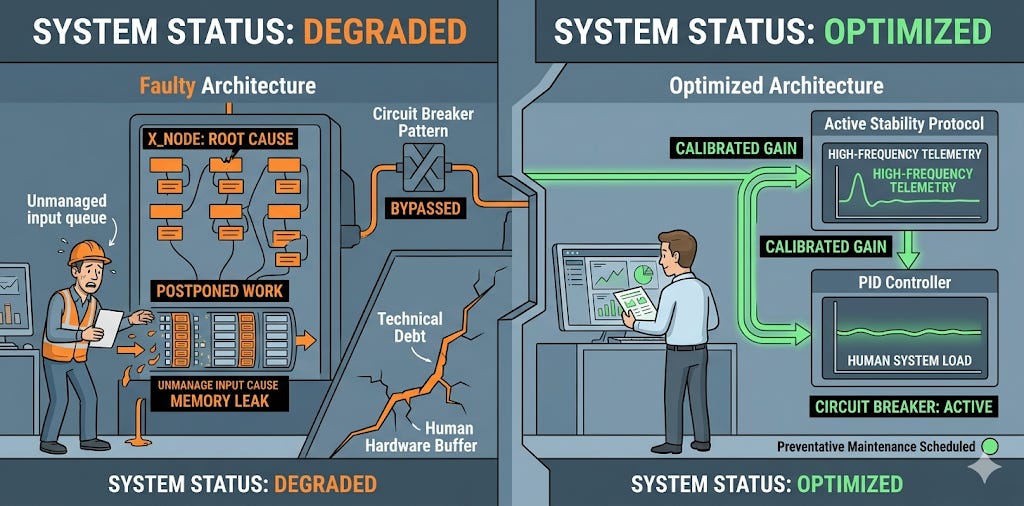
You took an extended weekend. You had a “great time.” You returned on Monday only to realize you did not actually recover. Then you took a week off. You returned to find an industrial-sized pile of postponed work. You felt less rested than when you left. This is not a mystery. It is a predictable outcome for a system with a broken control loop.
Taking a break while the underlying architecture is failing is like using a plastic shovel to clear a rock slide. You are not making a dent. You are just delaying the inevitable system crash.
The Myth of Vanity Metrics: Hours vs. Entropy
Your hours of work are a vanity metric. They provide no insight into the structural integrity of the human system. What matters is the systemic entropy generated by the work. Every task is a load on the processor. Every unmanaged priority is a memory leak.
It is easy to get in a lane and swim until you drown. You forget the initial set of priorities. You ignore the telemetry. You assume that if you just keep the services running, the system is healthy. This is the path to thermal throttling.
The System Audit: High-Frequency Telemetry
It is your duty to take a disciplined inventory of your goals. What was a critical interrupt last year may be data rot today. You must understand your burn rate.
Outside the office, social interaction, exercise, and leisure are not optional perks. They are scheduled maintenance cycles. They are the cooling systems for your hardware. If you do not fill the tank, the system will eventually brick itself.
Life outside the professional stack will fluctuate. It will introduce noise into your controller. You cannot ignore this variance. You must account for it in your active stability protocol.
The Conclusion: Re-Architecture vs. Reset
The totality of your work and life balance must focus on the balance part. Work has positive, neutral, or negative effects on your energy. Only you can monitor these telemetry signals.
If you do not actively manage these parameters, errors will accumulate. Memory will leak. You will experience a total system failure. A vacation is a soft reboot. It clears the cache but leaves the bugs in the code. You do not need a reset. You need a re-architecture.
The Request
Conduct a system audit this week. Do not wait for a full hardware failure. Review your energy levels, your current load, and your stress baseline. Identify one parameter that is causing the system to diverge. Implement a correction immediately.
System Library: Structural Integrity & Maintenance
These resources provide the mechanical blueprints for managing system load and preventing structural failure. Read them to understand the physics of your own hardware. Do not look for inspiration. Look for specifications.
Technical Debt and Human Systems
The definitive breakdown of how short-term shortcuts create long-term structural instability. Use this to diagnose the “Burnout Debt” accumulating in your organizational bedrock. If you are building on cracked concrete, no amount of polish will prevent a collapse.
A technical overview of how to prevent cascading failures by failing fast. This is the engineering requirement for implementing “The Request” regarding WIP limits and saying no. If you do not install a circuit breaker, the system will eventually ground itself through a total failure.
Manage Your Energy, Not Your Time
A rare piece of non-fluff analysis regarding human energy systems. It treats energy as a finite hardware resource rather than a vanity metric like “hours worked”. It provides the logic for why energy management is a maintenance requirement, not a lifestyle choice.
The Video: The Myth of 100% Utilization The Hardware Constraint. This QCon interview breaks down the neuroscience of cognitive load and the physical difference between necessary slack time and detrimental idle time. It provides the mechanical proof that pushing for maximum capacity utilization will inevitably lead to systemic burnout and a complete failure in decision-making. If you do not schedule downtime for the system, the system will schedule it for you.
System Status: Degraded.
Theory is for brochures. Engineering is for survival. If your internal sensors are reporting irritability or cognitive lag, your system is already diverging. Fix the control loop before the engine seizes.
Review the operating parameters at weivco.com.
Elsewhere: I write about building software with AI at The Old Man and the AI, and I build Fractbox, a browser-based 3D fractal engine.