
The Scarcity Mindset: Why Your "Outdated" Anxiety is Now a Superpower
For 15 years, Silicon Valley rewarded the "Abundance Mindset." Now, the bill is due, and the engineers who grew up with nothing are the ones who can fix it.

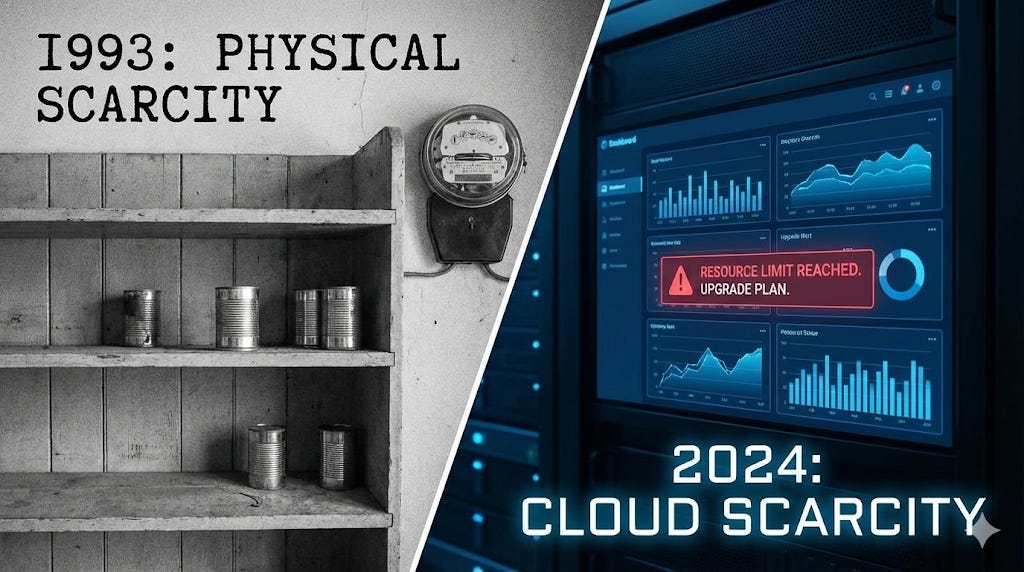
The $50 Steak vs. The Empty Fridge
There is a fundamental difference between someone who is frugal because they are saving for a Tesla, and someone who is frugal because they remember empty grocery shelves.
I grew up in Yugoslavia during the hyperinflation of the 90s. When you have lived in an economy where money loses half its value between breakfast and dinner, “efficiency” isn’t a strategy. It’s a survival mechanism. You don’t waste anything. You do your best to fix the toaster because you can’t buy a new one. You walk in order not to pay for a bus ticket. You treat every resource as finite because, in your world, it is.
Then, I moved to Silicon Valley.
The Culture Shock of Infinite Compute
Walking into a Big Tech company in the mid-2000s felt like landing on a different planet.
It wasn’t that the engineers were wasteful. Quite the opposite - my colleagues were brilliant. They were obsessed with optimization. They would spend weeks shaving 5 milliseconds off a query or improving bin-packing efficiency by 1%.
But they were optimizing for Scale, not Scarcity.
They built systems that could handle a billion users, even if we only had zero users today.
They solved problems by building custom distributed infrastructure because “standard” tools weren’t efficient enough at massive scale.
The baseline unit of compute wasn’t a “server”; it was a “cluster.”
For them, “being smart” meant maximizing the utilization of a massive, existing resource pool. For me, coming from hyperinflation, “being smart” meant not spending the money in the first place.
It triggered a deep, instinctual anxiety. Watching a system spin up 500 machines to process a log file (very efficiently!) felt like watching someone light a cigar with a burning $100 note. Sure, the cigar got lit, and the flame was very consistent, but the cost felt visceral.
I felt like the grumpy dinosaur. I thought, “Why are we burning so much RAM? Why not just write better code?” They looked at me and said, “Engineer time is more expensive than compute time. Move fast.”
And for 15 years, they were right. Interest rates were zero. Venture capital was infinite. The cloud was an all-you-can-eat buffet.
But the buffet is closed.
The Return of Physics
We are now entering the era of the “Cloud Hangover.”
Interest rates are up. VC money has dried up. CFOs are suddenly looking at those cloud bills and asking, “Why are we paying $50,000 a month for ‘Dev Environment Logs’?”
Suddenly, the scarcity mindset isn’t outdated. It is the most valuable skill in the room.
If you are an engineer from a background of scarcity - whether that was Eastern Europe, or just a bootstrapped startup running on fumes - you have a mental framework that is suddenly in high demand.
You are no longer the “grumpy old man” complaining about memory usage. You are the only adult in the room who understands that the credit card bill eventually arrives.
How to Lead with Scarcity (Without Being a Jerk)
You don’t want to be the manager who refuses to buy people good laptops. That’s not scarcity; that’s stupidity. But you do want to be the leader who treats compute like physics.
1. The “Cloud Tax” is Real Money: In the 80s, we fixed things because we couldn’t buy new ones. Today, we need to instill that same “Repair Culture” in Cloud architecture.
The Abundance Leader sees a cloud bill increase of 20% and says, “It’s the cost of growth.”
The Scarcity Leader looks at the bill and sees the burning $100 note. They drill down and realize we are paying storage fees for 50TB of logs that no human has read in three years.
2. Architect for Constraints: I currently run local AI models on my personal hardware. Why? I could easily pay for a foundational model API key. I do it because constraints force creativity. When you only have 24GB of VRAM, you have to learn about quantization. You have to understand the difference between FP16 and INT4. You have to understand the metal of the machine.
Engineers who only use APIs treat compute like magic. Engineers who run local models treat compute like physics. You want the latter leading your AI strategy.
3. Efficiency is a Feature: For years, performance optimization was something you put in the “backlog” - the graveyard where tickets go to die. Today, efficiency is the product. Lower latency means better UX. Lower inference cost means higher gross margin.
The Summary
If you have that nagging voice in your head that says, “Do we really need a microservice for this?” or “Why is this Docker image 4GB?” do not silence it.
That voice is not “legacy thinking.” That voice is margin.
The industry spent 15 years partying on cheap money. The lights just turned on, the music stopped, and the bill has arrived. They don’t just need someone who knows how to code. They need someone who knows the cost of the code.
Do you remember standing in a line on a winter morning to get a liter of milk? Drop a comment below!
Further Reading (For the “Cheap” Engineers)
If you want to arm yourself with data the next time someone calls you a penny-pincher, read these.
1. The Bible: Cloud FinOps (O’Reilly) If you are serious about this, this is the manual. It moves the conversation from “saving money” (which sounds boring) to “unit economics” (which sounds strategic). It teaches you how to charge teams for their own usage, which is the fastest way to fix bad code.
2. The Concept: “Mechanical Sympathy” Coined by Martin Thompson (a legend in high-frequency trading), this concept states that you don’t need to be a hardware engineer, but you must understand how the hardware behaves to write good software.
The Grumpy take: If you don’t know what a CPU cache line is, you have no business complaining about latency.
3. The Trap: Jevons Paradox Be careful. This economic theory states that as technology increases the efficiency with which a resource is used, the total consumption of that resource increases rather than decreases.
Why it matters: If you make the system 10x more efficient, the product manager will just send 100x more data through it. Efficiency doesn’t always lower the bill; sometimes it just enables scale.
4. The Classic: The Goal by Eliyahu Goldratt It’s a manufacturing novel from the 80s, but it teaches Constraint Theory better than any CS textbook. It explains why “optimizing” a non-bottleneck resource is a total waste of time (and money).