
Silence is Data: Reading the Leaked Telemetry of a Meeting
When the official verbal API is returning 200 OK, but the system metrics are screaming.

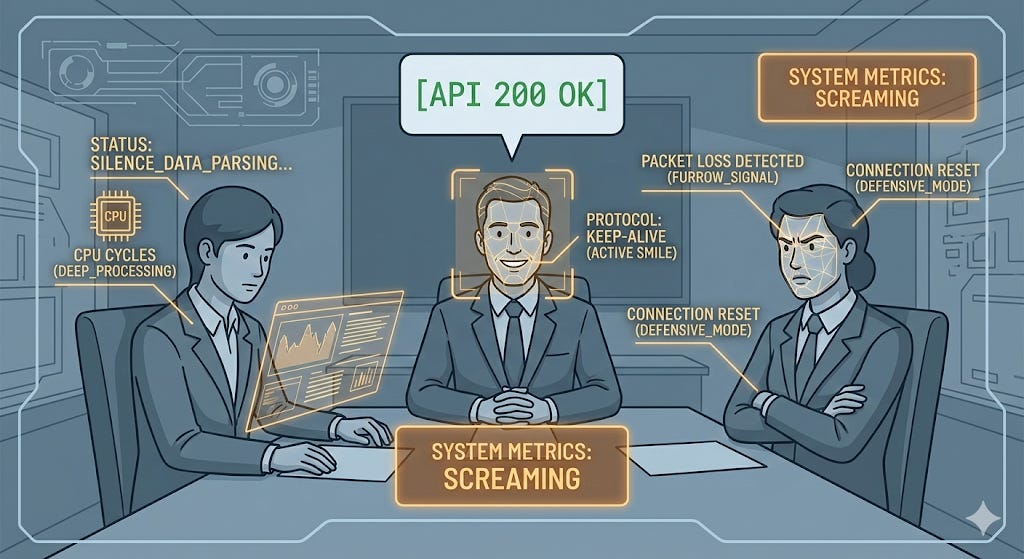
In engineering, you do not just look at the dashboard. You look at the logs, the heat maps, and the packet loss. Professional interactions are no different.
The biggest mistake junior leaders make is listening only to the words. They assume that if no one said “No”, then everyone agreed. That is a dangerous assumption. Verbal communication in Big Tech is often a “Lossy Protocol”. It is compressed by corporate politeness and career preservation.
The real data, the high-fidelity signal, is in the silence and the non-verbal leakage.
The Deception of the Smile
There is a common, amateurish trope. “When they stop smiling, you are in trouble.”
This is an oversimplification. A smile in a US meeting room is often just a “keep-alive” signal. It does not mean the other person agrees with you. It just means they have not crashed yet. Relying on a single cue like a smile is like monitoring a distributed system by only checking if the power light is on.
You need to look at the clusters of signals.
Decoding the Cluster: Micro-expressions and Micro-faults
Effective interpretation requires observing signal clusters. When the words say “This looks good” but the telemetry says otherwise, look for specific faults.
The Jaw Tightening (Jitter): A sudden tightening of the jaw muscles during a budget review is a spike in latency. It suggests underlying tension that the speaker is trying to suppress.
The Brow Furrow (Packet Loss): A brief furrow when you mention a specific feature means they have lost the thread or they have detected a bug in your logic.
The Physical Pullback (Connection Reset): If a counterpart is leaning in and suddenly leans back or crosses their arms when you mention a deadline, they have just disconnected from the proposal. They are now in defensive mode.
Silence as a Strategic Pause vs. a System Hang
Silence is not a void. It is a data point. You have to know how to parse it based on the Contextual Environment.
In Low-Context (US) Environments: Extended silence is often a “Time-out”. It usually indicates discomfort, disagreement, or a formulation of a rebuttal. If you hit them with a proposal and they go quiet for five seconds, you have likely hit a “Critical Error”.
In High-Context (Global) Environments: Silence can be “Deep Processing”. In some cultures, silence is a sign of respect. They are giving your data the CPU cycles it deserves.
If you assume silence always means “No”, you are an amateur. If you assume it always means “Thinking”, you are a target.
The Vocalics of Intent
The way words are spoken is the Metadata. Changes in tone, pitch, or pace convey the actual intent.
A sudden drop in vocal pitch or a prolonged pause before responding is a “Throttling” maneuver. They are deliberately slowing down the data transfer to control the information. Individual cues are meaningless in isolation. However, when a lack of smiling is combined with folded arms and a sharp tone, the system is in a Fatal Error state.
Leadership Action: Developing Your Own Telemetry
Non-verbal literacy is a continuous debugging skill. To improve your system, run through these steps.
Look for Inconsistencies: If the verbal output is “Yes” but the body language is “Crossing Arms”, trust the body language. It is the raw log. The words are just the PR-friendly UI.
Test the Hypothesis: If you observe a negative cluster, do not guess. Run a probe. “I sense some hesitation on the timeline. What specific constraint am I missing?”
Monitor Your Own Output: Are you inadvertently leaking “Aggression” packets? Record your mock meetings. Identify the unconscious habits that are causing “Packet Loss” in your team’s communication.
Those who master the subtleties of unspoken communication gain a competitive advantage. They do not guess. They perform Informed Interpretation.
Stop listening to the fluff. Start reading the data.
Share Your Logs
I want to see your error reports. What is the most obvious non-verbal “fatal error” you have witnessed in a design review or a management meeting? Drop your telemetry in the comments below. Let us build a shared library of known bugs.
System Library: Further Reading
Tools for refining your non-verbal sensors.
The Book: What Every BODY is Saying by Joe Navarro
The Engineering Angle: Written by a former FBI profiler. This is the technical manual for human “tells”. It breaks down non-verbal cues into “Comfort” vs. “Discomfort” clusters. This is the binary of human interaction.
The Article: The Silent Language of Leaders
The Engineering Angle: A look at how body language impacts leadership presence. It treats your physical stance as the “Hardware” that supports your verbal “Software”.
The Video: Micro-expressions: The Science of Reading Faces
The Gist: A visual guide to the micro-leaks that reveal true emotion before the conscious mind can suppress them.
System Status: Critical?
Writing about management is theory. Fixing it is engineering.
If your organization is suffering from high latency, packet loss in communication, or structural debt, I provide Strategic Debugging and Leadership Mentoring.
Review my operating parameters at weivco.com.