
Onboarding: The Dark Room
Ignorance Buffer vs. Time-to-Help Threshold.

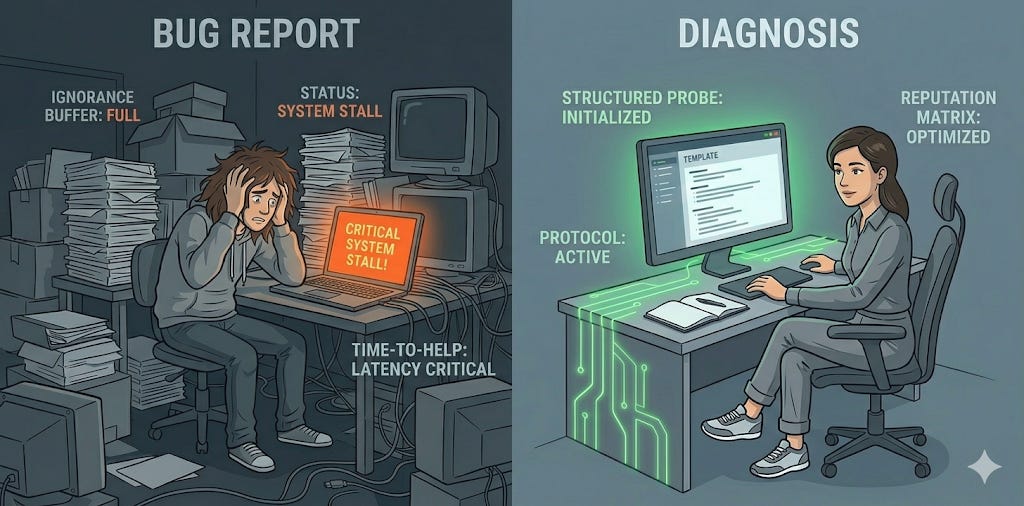
You cleared the interviewing loop. You survived the compensation negotiations. You filled out the HR paperwork, collected your badge, and provisioned your laptop. You sat through the performative compliance orientation.
Now what?
If your team’s processes aren’t entirely broken, your manager or mentor just assigned your first starter task. You are now expected to execute using the unindexed information firehose you were forced to drink from for the last two weeks. Within hours, you hit a wall. The code does not compile. Your commit is blocked by a pre-hook. Worse, you realized you do not actually understand the architecture of the task.
What now?
The Onboarding Paradox: High Latency vs. Interrupt Flooding
Onboarding is a high-stakes, low-frequency systems integration. Unlike daily capacity management, it happens rarely, but it establishes the initial baseline for your reputation.
New hires are forced to operate in a dark room. Joining a mature engineering organization is like entering a hoarder’s storage facility without a flashlight. The infrastructure is a web of unwritten rules, legacy dependencies, and cargo-cult architecture. Pulling on one thread can trigger a systemic buffer overflow.
This creates a dangerous trade-off between two catastrophic failure modes:
Interrupt Flooding: Asking for help the moment you encounter a blocker. This transforms you into a high-latency dependency for your peers and signals an inability to operate independently.
System Stall: Sitting in silence, grinding your gears for days to avoid looking incompetent. This results in zero throughput, missed delivery thresholds, and immense personal frustration.
Neither state is acceptable. You must calibrate your control loop.
The Protocol: The Senior Debugging Probe
When you are the newcomer, you are the component being benchmarked. To pass the integration test, you must deploy a structured debugging probe before you flood the team’s communication channels.
Faced with an error, execute the following runtime loop:
Formulate a hypothesis.
Test the hypothesis.
Log the delta between expected behavior and actual output.
Audit the documentation for outdated specifications and log the gaps.
If the system remains blocked after this loop, execute a structured help request. Never post “It doesn’t work.” That is garbage input. Use the standardized format:
Context: I am attempting to accomplish objective X.
Telemetry: I have executed actions A, B, and C, resulting in output Y.
Documentation Delta: The runbook states condition Q, but the system is throwing error Z.
The Request: What structural parameter am I missing?
This protocol immediately signals to your team that you have performed the necessary pre-computation. It lowers their cognitive load to assist you, converts a vague complaint into a crisp engineering problem, and makes the interaction highly efficient.
Camp Site Cleanup and Timeboxing
Once the blocker is resolved and the code compiles, leave the codebase cleaner than you found it. Do not just close the ticket and walk away. Fix the broken documentation. Commit the corrected runbook. Log the hidden dependency. Say thank you to the engineer who unblocked you, then update the team’s central knowledge base so the next hire does not encounter the same packet loss.
The critical variable to tune is your Time-to-Help Threshold.
How long do you struggle before you trigger an interrupt? Do not rely on emotional telemetry like frustration levels; by the time you feel like you are going insane, your processor has already overheated. Timebox your efforts mechanically. If you spend more than four hours spinning your wheels on a single local blocker, your sampling rate is too low. Trigger the request protocol. As your local ignorance buffer shrinks, tuning this threshold will become intuitive.
The Request
Analyze your onboarding pipeline or your last system integration. Did you stall out in silent frustration, or did you flood your peers with unparsed error logs? Share your onboarding post-mortems, your system blind alleys, and your operational failures in the comments below.
System Library: External Technical Bedrock
The Blueprint: The Care and Feeding of New Engineers
An architectural guide on setting up onboarding paths that don’t rely on tribal knowledge. Read this to understand how functional engineering organizations minimize time-to-throughput for new components.
The Communication Protocol: How to Ask Questions the Smart Way by Eric S. Raymond
The definitive guide on minimizing communication packet loss in technical environments. It provides the exact mathematical rationale for why structured help requests yield high-fidelity answers.
The Software Principle: The Boy Scout Rule by Martin Fowler
An analysis of opportunistic refactoring. It explains why leaving the campsite cleaner is not a polite suggestion, but a core architectural requirement for controlling software decay.
System Status: Critical?
Writing about management is theory. Fixing it is engineering. If your organization is suffering from high latency, packet loss in communication, or structural debt, I provide Strategic Debugging and Mentoring. Review the operating parameters at weivco.com.