

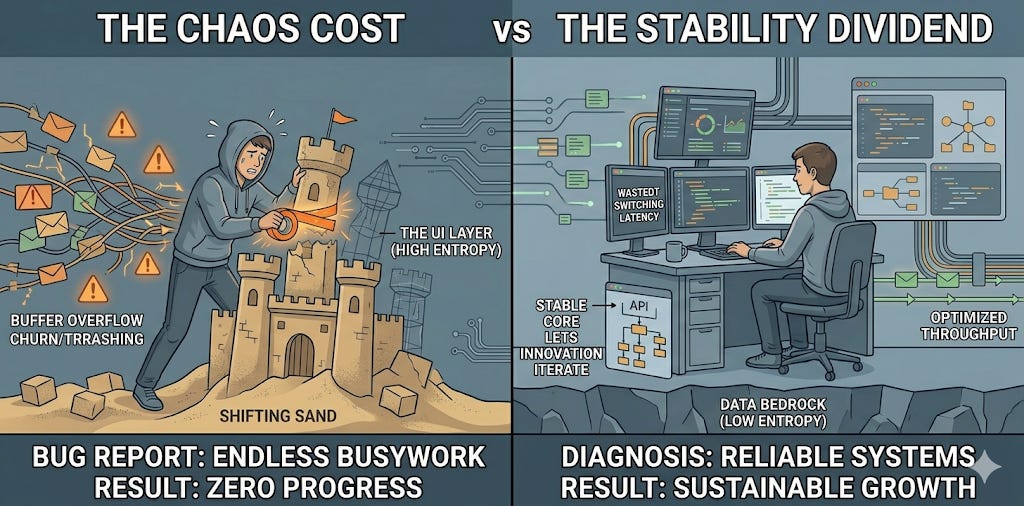
Organizations are wasting fortunes because of a fundamental misunderstanding of how systems work. Management constantly invests in things that are in a state of chaos - elements that change without warning, usually for no good reason. This introduces massive volatility into the business. It burns out employees, wastes money, and creates expensive noise. It ensures that no solid foundation ever forms.
Think of it like building a house. It is fine, and expected, that you might paint the walls or change the furniture often. That is the superficial layer (the “User Interface”). But if you are constantly ripping out and moving the plumbing and electrical wiring (the “Core System”) because of a new trend, the house becomes uninhabitable. The workers just keep re-doing their work, nothing gets finished, and the costs skyrocket. Your core logic must be a stable, reliable foundation so the superficial layers can iterate without collapsing the whole structure. You must prioritize the core.
The Busywork Trap: Endless Improvement, Zero Progress
The most dangerous way organizations fail is by falling into the “Busywork Trap.” Everyone looks incredibly active. Teams are constantly reworking internal systems, supposedly “improving” things. Yet, nothing actually gets finished and delivered to the customer. This looks like innovation, but it is just expensive running in place.
A product team might spend a year rebuilding internal engines to prepare for some hypothetical future traffic, chasing a new buzzword. Meanwhile, current customers are stuck with bugs. New features ship slowly, if at all. Every “improvement” to the engine creates new problems elsewhere, breaking things that used to work. Everyone is exhausted, but the business isn’t moving forward. This is waste, not innovation. It is a failure to identify and protect the things that should rarely change.
The Proposed Fix: Lock Down the Foundation
The fix is simple: build a solid foundation and lock it down. Identify the components of your business that shouldn’t change and protect them. Invest heavily in these core elements - your foundational data, your essential business rules, and the clear rules for how systems talk to each other.
This approach is boring. It doesn’t generate exciting press releases or win “innovation awards.” But it is reality over optics. It builds a predictable system, reduces expensive mistakes, and frees up resources to focus on actual innovation.
Imagine a company that dedicates 80% of its budget for a year to simply solidifying its infrastructure. The optics are bad; there are fewer “shiny” new features for a while. But the business becomes reliable. Future changes become cheaper, faster, and less risky. This is an investment in long-term speed.
Real Stability Means Smart Management
Prioritizing stability is not about resisting change. It is about smart management. The goal is to build a core so stable that you can change the paint and furniture on the surface ten times a day without breaking the cash register.
Consider two companies. Company A chases every new technology trend, constantly rebuilding its entire operation every 18 months. Company B deliberately builds a stable core. It uses proven, reliable methods for its foundation and invests in clear rules. Company A appears “innovative” on paper. But it suffers constant outages, its teams are burned out, and its progress is entirely unpredictable. Company B appears “slow” initially. But over time, it achieves much faster, more reliable growth. Its system is more resilient. Reality always wins. Optics always lose.
Proposed Action
Audit your current projects. Find the parts that are changing the most. Is that constant change necessary, or is it a sign that you are building on shifting sand? Identify the core parts of your business that must be stabilized immediately. Do it this week.
Share Your Tales of Chaos
I want to hear about your most expensive examples of running in place. When did a “major restructuring” generate massive costs with zero value delivered? Post your stories in the comments.
System Library: Further Reading
Tools for foundational stability and volatility management.
The Book: Designing Data-Intensive Applications by Martin Kleppmann
The Engineering Angle: If you are building core infrastructure, this is your operating manual. It ignores the hype cycles and focuses strictly on the physics of reliable, scalable, and maintainable data systems. Essential reading for stabilizing your bedrock.
The Concept: Pace Layering
The Logic: Stewart Brand’s framework for understanding how different layers of a system change at different speeds. It helps you diagnose why trying to make your core database (low entropy) move at the speed of fashion (high entropy) causes a system-wide fault.
The Article: Choose Boring Technology by Dan McKinley
The Gist: A pragmatic guide to technology selection. It argues that you should spend your “innovation tokens” on your core business problem, not on the low-entropy foundational tech. Required reading for anyone suffering from Perpetual Refactoring Syndrome.
System Status: Critical?
Writing about management is theory. Fixing it is engineering.
If your organization is suffering from high latency, packet loss in communication, or structural debt, I provide Strategic Debugging and Leadership Mentoring.
I refactor your team like you refactor your code.
Review my operating parameters at weivco.com.