
Feature Requests are Not Requirements
Stop building what they ask for. Debug what they actually need.

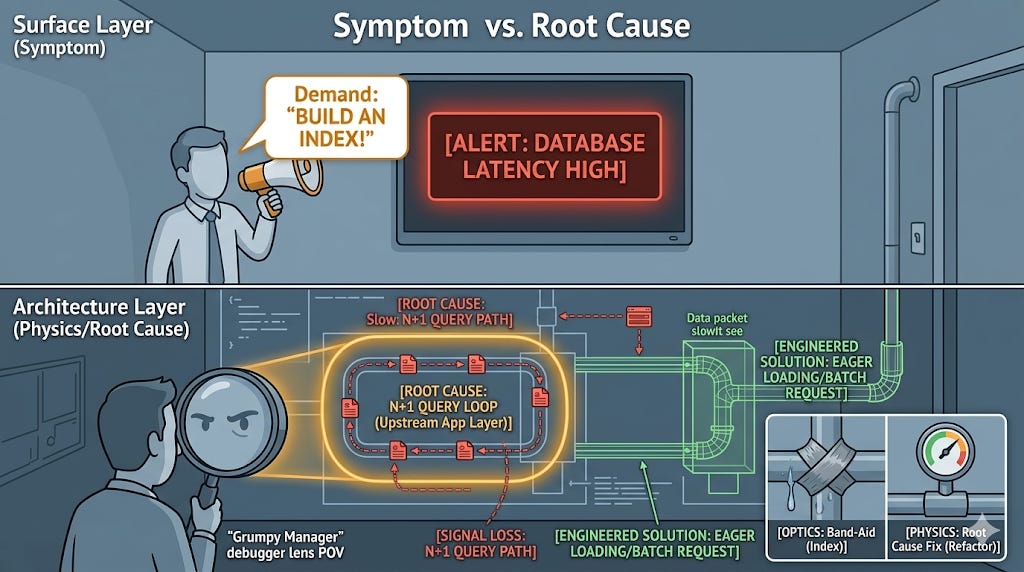
Your inbox is a queue of proposed solutions. “Build this button.” “Add that field.” “Create this index.” These are not requirements. These are guesses. They come from people who lack system context. They are trying to help. They are usually making things worse.
This anti-pattern is a fundamental specification defect. Stakeholders and clients present an implementation rather than the underlying problem. They see a slow page. They demand a database index. This bypasses the critical diagnostic phase. It treats symptoms as diagnoses. It leads directly to suboptimal architecture. You become a code monkey. You cease to be an engineer.
Operating Conditions: The Specification Defect
Consider the database index request. A team complains about a slow query. Their “solution” is a new index. This is a local optimization. It might offer temporary relief. It often masks a deeper architectural flaw. It is like patching a leaky pipe with duct tape. It looks like progress. It is not.
Every request serves a higher purpose. Your job is to uncover the real objective function. This is the desired system state. It is not “create index on column X.” It is “reduce checkout abandonment by 10%.” The stated “feature” is merely a proposed mechanism. It is a guess at how to achieve the objective. Your role is not to fulfill the guess. Your role is to understand the objective. Then, you engineer the optimal mechanism.
I/O Protocol: Decomposing The Request
Treat every feature request as a bug report for the system’s current behavior. Your first step is diagnosis. Not implementation.
Decomposed requests require a stack trace. Start with “why.” Then ask “why” again. And again. Map the requested feature to the actual workflow. What specific action triggers this need? What business process does it support? What is the specific undesirable system behavior today?
For the slow query, do not just build the index. Run this protocol:
Why is this query slow? (Initial symptom).
Why is this query executed in this manner? (Reveals application logic).
Why does the application execute it this way? (Points to design choices).
Why was that design choice made? (Uncovers original constraints).
Why is the current performance unacceptable? (Quantifies business impact).
This protocol separates the what (the objective) from the how (the proposed solution). It uncovers the actual problem definition.
System Status: Engineering the Correct Solution
Understanding the root problem allows you to engineer the correct solution. This avoids accumulating design flaws. It reduces future maintenance load. It builds robust, scalable systems.
Implementing a feature request without debugging the root cause is like increasing the timeout on a failing API call. You have not fixed the latency. You have only made the eventual failure more expensive.
If the “slow query” is due to an N+1 problem, the fix is not an index. The fix is in the application layer. You must eager load data. You must batch requests. You must restructure the API calls. An index is a band-aid. It is a local optimization. It adds complexity without solving the fundamental issue. It is more technical debt. The right solution is often upstream. It requires more thought and less immediate coding. This is engineering.
Proposed Fix
Stop accepting feature requests as gospel. Treat them as initial data points. Every request is a symptom. Your job is to debug the system. Not just implement the reported symptom.
This week, for the next request you receive, do not estimate it. Do not scope it. Ask “why” at least three times before you write a single line of code. Understand the objective function. Ignore the proposed mechanism.
Share Your Stack Traces
What is the most technically bankrupt “solution” a stakeholder has ever demanded you build? How did you redirect them to the actual problem? Share your debugging stories in the comments.
System Library: Further Reading
Tools for root cause analysis.
The Concept: The XY Problem
The Logic: A detailed breakdown of why people ask about their attempted solution (Y) rather than the actual problem (X). This is the primary bug in all requirements gathering.
The Book: The Mom Test by Rob Fitzpatrick
The Engineering Angle: This is a manual for extracting data from biased sensors (people). It teaches you how to ask questions that reveal facts rather than opinions.
The Video: Root Cause Analysis with 5 Whys
The Gist: A visual demonstration of the “Why” protocol used to move past symptoms and identify the systemic failure.
System Status: Critical?
Writing about management is theory. Fixing it is engineering.
If your organization is suffering from high latency, packet loss in communication, or structural debt, I provide Strategic Debugging and Leadership Mentoring.
I refactor your team like you refactor your code.
Review my operating parameters at weivco.com.
Need vs. Want, I dig it!