
Escalation: The Triage Nurse
Interrupt Handler Priorities.

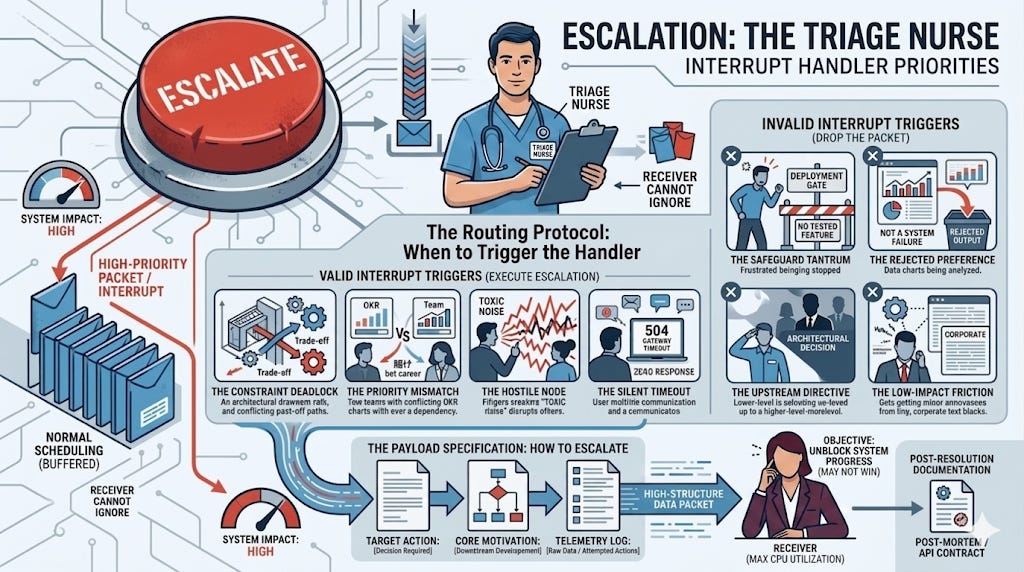
In every engineering organization, there is a giant, red button. It is invisible, but it exists. If it were visible, it would have the word “ESCALATE” stenciled across the chassis. This button is a direct hardware interrupt. It bypasses normal scheduling and demands the immediate attention of the processor above you. Handling escalations is a core function of the management layer, but misusing this interrupt is a rapid way to degrade system performance.
An escalation is designed to resolve a deadlock where all local threads have executed to completion without success. It requires interrupting a manager, a director, or a cross-functional lead, forcing them to reallocate their cognitive cycles to your local block.
You have this interrupt at your disposal. You must calibrate the threshold for triggering it.
The Mechanics of the Interrupt: What Escalation Actually Cost
First, you must understand the system impact of the button. The receiver cannot ignore an escalation. It is a high-priority packet that must be parsed immediately.
For the receiver, an escalation is almost always an unpleasant surprise. It provides definitive data that the organization is not operating according to the design specification. The manager must now pause their current execution, analyze an unindexed situation, and make a high-stakes decision.
More often than not, resolving an escalation requires a trade-off that leaves one or more parties dissatisfied. It is not an administrative task. It is an expensive, high-entropy intervention.
The world is messy, populated by humans, and characterized by conflicting priorities. Sometimes a deadlock cannot be broken with local authority. When priorities clash and the issue cannot be buffered for later, you must trigger the handler.
The Routing Protocol: When to Trigger the Handler
The art of escalation requires precise input filtering. You should only trigger the interrupt when you have verified that local execution has failed, or when the issue matches specific systemic fault criteria.
Valid Interrupt Triggers (Execute Escalation):
The Constraint Deadlock: A technical problem has two viable solutions with competing architectural trade-offs, and it is unclear which organizational constraint takes precedence.
The Priority Mismatch: A partner team rejects your proposals due to a structural conflict in their own OKRs. You have attempted to restructure the collaboration, sweetened the pot, and are willing to bet your career that the dependency is critical to the roadmap.
The Hostile Node: A colleague is acting unprofessionally, introducing toxic noise into the environment, and degrading the throughput of the team.
The Silent Timeout: You have attempted to resolve a situation across a standard interface, but the downstream team is returning a 504 Gateway Timeout—zero response after a reasonable number of retries.
The common thread is clear: you have exhausted your local tools, knowledge, and authority. The system is deadlocked.
Invalid Interrupt Triggers (Drop the Packet):
The Safeguard Tantrum: Someone is enforcing a deployment gate and preventing you from pushing an untested feature directly to production.
The Rejected Preference: You made a data-driven argument for your preferred solution, and it was deliberately reviewed and rejected. Rejection is an output, not a system failure.
The Upstream Directive: You simply disagree with an architectural decision that was made above your level.
The Low-Impact Friction: You dislike minor operational details, corporate wording, or trivial friction.
Escalating in these scenarios will not change the execution output. It will merely provide the management layer with definitive telemetry that you do not understand the system boundaries.
The Payload Specification: How to Escalate
The person receiving your escalation is already running at maximum CPU utilization. Do not send them a vague complaint. Provide a highly structured data packet optimized for fast parsing.
Construct your payload using this explicit sequence:
The Target Action: State exactly what decision or resource allocation you require from them.
The Core Motivation: Detail why you are escalating, specifying the exact downstream consequences of non-action (e.g., project delay, resource starvation).
The Telemetry Log: Provide the raw data necessary for a deep dive, explicitly listing the local actions you have already executed to resolve the deadlock.
By structuring the payload this way, you maximize the probability of an optimal resolution. Be aware that the runtime decision may not go in your favor. You must be prepared to disagree and commit. The objective of an escalation is not to guarantee you win; the objective is to unblock system progress.
Post-resolution, document the output. Escalations are incredibly expensive system operations. If writing a post-mortem or updating an API contract can prevent the same race condition from occurring next quarter, it is worth the documentation overhead.
The Request
Analyze the escalation protocols in your current organization. Are you handling deadlocks efficiently, or is your team spamming the big red button for trivial linting errors? Share your configuration post-mortems, your colorful escalation failures, and your operational routing strategies in the comments below.
System Library: Interrupt and Conflict Architecture
The Protocol: The Disagree and Commit Standard
Andy Grove’s foundational logic on structural execution. It explains why a system cannot allow perpetual processing loops. Once a decision is rendered by the controller, all nodes must execute the output regardless of prior state biases.
The Hardware Analogy: Interrupt Handlers and Priorities
A technical review of how operating systems handle asynchronous events. Read this to understand the physical cost of context-switching a processor and why low-priority tasks must never mask critical system interrupts.
The Resolution Framework: High-Output Management by Andy Grove
The definitive guide on organizational throughput. Chapter 3 breaks down how to handle structural conflicts and why escalating early with clean data is superior to letting a project rot in a silent deadlock.
System Status: Critical?
Writing about management is theory. Fixing it is engineering. If your organization is suffering from high latency, packet loss in communication, or structural debt, I provide Strategic Debugging and Mentoring. Review the operating parameters at weivco.com.