
AI Usage: The GPS Trap
Why outsourcing your primary processor is bricking your local hardware.

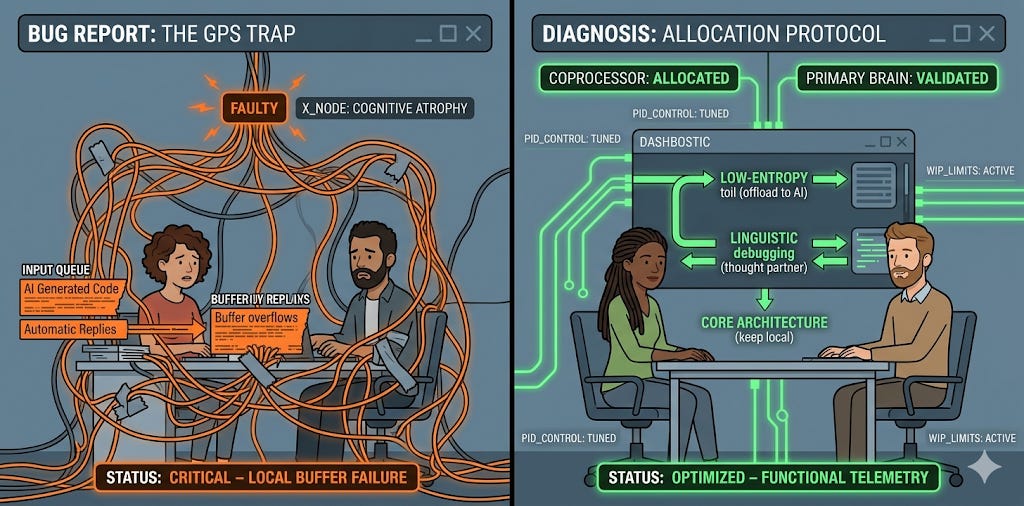
Corporate leadership is pushing AI down our throats like kale in a tech-cafeteria. The temptation to offload the initial processing of a blank page is real. If you write code, the temptation to let a coprocessor generate thousands of lines per day is even higher. It causes severe cognitive atrophy.
AI is an efficient text parser and summary generator. It is also an architectural trap. You are outsourcing your primary CPU cycles to an external cloud service, and your local memory structures are paying the price.
The GPS Analogy: Rotting the Hippocampus
Consider automotive navigation. Before GPS, you had to pre-compute your route. You parsed physical maps, calculated spatial vectors, and handled real-time telemetry. Today, you input a destination and mindlessly follow turn-by-turn prompts. You have completely offloaded spatial computation.
According to a 2020 study in Scientific Reports, this level of automation actively degrades human spatial memory structures. When you eliminate navigation friction, your brain stops building internal maps. You are letting your local navigation hardware rot.
The Evolution of Cognitive Offloading
Engineering used to require a high-friction compilation loop. Decades ago, finding documentation meant analyzing physical manuals or locating a photocopy of a photocopy of a reference guide. The dawn of the internet reduced this data retrieval latency, but you still had to process the raw syntax and struggle through the implementation.
By 2025, you could ask an LLM to digest the parameters for you. Now, in 2026, the tool doesn’t just explain the architecture. It executes the entire task on your behalf. You do not even need to understand the logic, you just dictate the desired output.
You have eliminated the struggle. In doing so, you have bypassed the exact compilation process required to build deep mental models. If you do not struggle with the syntax, you do not own the architecture. You are just a configuration manager for a system you do not understand.
How to Allocate
To survive this shift, you must treat AI as a secondary coprocessor, not a replacement for your central processing unit. Map your daily execution queue based on cognitive load and allocate resources mechanically.
Low-Entropy Toil (Offload): Tasks with zero architectural depth are prime candidates for AI execution. Use it for sorting ticket queues, generating daily status summaries, or reformatting raw data structures. This is pure background maintenance that reduces low-value toil.
Linguistic Debugging (Partner): Do not let an LLM write your primary communication drafts. If you do, you enter a dead loop where machines write prose for other machines to summarize. Write the initial logic yourself. Use the model exclusively to proofread, stress-test, and critique your parameters.
Core Architecture (Keep Local): For high-complexity tasks and unfamiliar domains, embrace the execution friction. Use the AI to explain foundational math or obscure APIs, but write the code and construct the logic by hand. If you do not run the computation locally, your brain keeps a pointer to the answer with no memory allocated behind it.
Embrace the struggle. Friction is the only mechanism that validates your local hardware buffer.
The Request
Run a hardware validation test this week. Disable your navigation GPS for one trip and analyze the cognitive engagement required to map the vectors. Then, isolate one complex engineering task at work and execute it entirely by hand without opening an LLM interface. Identify the exact spots where you feel lost. That local buffer failure is where learning actually occurs.
Share your system post-mortems in the comments below. How are you maintaining your local processing capacity in a world designed to automate your thinking?
Further Reading
The Study: Habitual Use of GPS Negatively Impacts Spatial Memory
The Biological Telemetry. A scientific analysis detailing how outsourcing navigation tasks results in measurable degradation of local brain structures.
The Mechanism: The Science of Thinking by Veritasium
Derek Muller’s breakdown of why understanding only forms under load. Fluency feels like comprehension, but it is a cache hit on someone else’s computation. The video shows why the struggle you are tempted to automate away is the exact process that writes the model to local memory.
The Warning: Is Google Making Us Stupid? by Nicholas Carr
The original diagnostic report on digital information processing. It outlines how low-latency information loops re-wire our neural circuits, trading deep processing capacity for shallow scanning efficiency.
Need help?
Writing about management is theory. Fixing it is engineering. If your organization is suffering from high latency, packet loss in communication, or structural debt, I provide Strategic Debugging and Mentoring. Review the operating parameters at weivco.com.